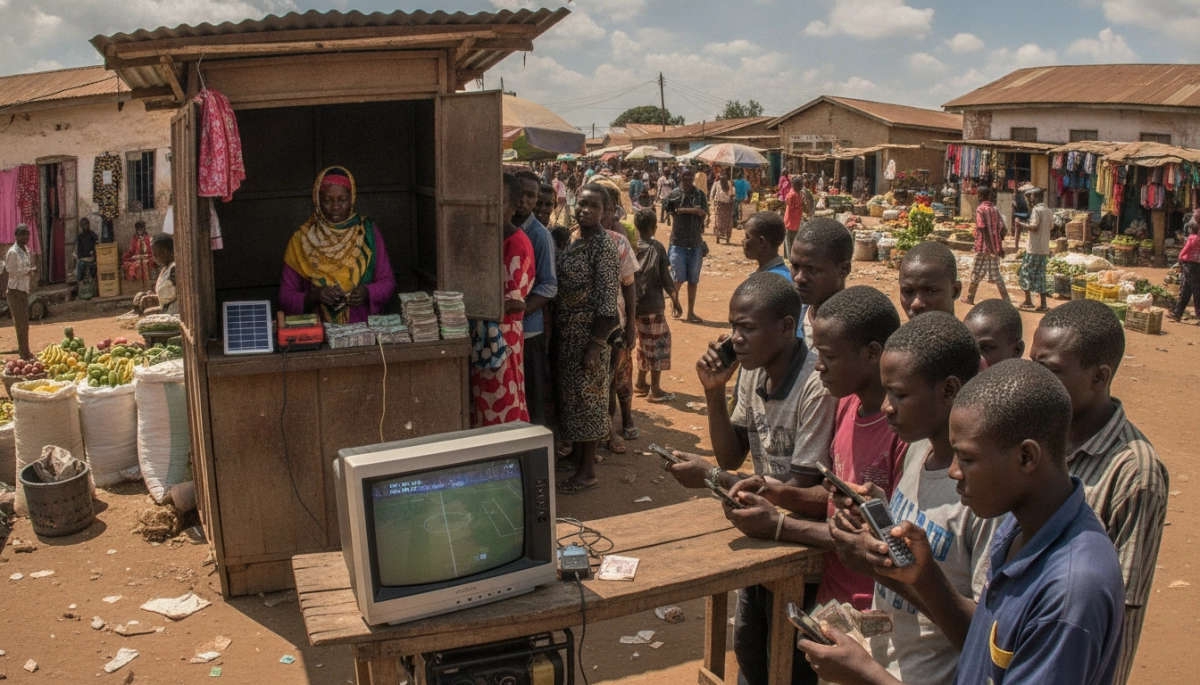

Why the Tanzania Premier League Is One of the Hardest Markets to Bet Profitably
Most bettors who follow Tanzanian football assume that familiarity with local clubs gives them an edge. They know the teams, they watch the matches, and they have opinions about form. What they underestimate is how little that knowledge helps when the market itself is structurally designed to favour the bookmaker. Tanzania Premier League betting is not simply a smaller version of English Premier League betting. It operates on entirely different mechanics.
Understanding why requires looking past the odds and examining what produces them. Three compounding problems drive the difficulty: a near-total absence of reliable public data, markets with very little liquidity, and bookmaker pricing that does not respond to sharp money the way European markets do.
The Data Problem Most Bettors Ignore
Sharp betting in any market depends on building a picture of likely outcomes more accurate than the bookmaker’s model. In the Premier League, that is difficult but achievable. Years of granular data exist across multiple public platforms — expected goals, team press intensity, injury records, head-to-head performance under specific conditions — already being used by professionals to find edges.
The Tanzania Premier League operates in a completely different information environment. Consistent match statistics are hard to source. Historical head-to-head records with context around team composition are rarely documented publicly. Injury updates are inconsistent and often arrive too late to influence pre-match positioning. Without reliable data, building an accurate probability model is largely guesswork dressed up as analysis.
This creates a situation where both bettor and bookmaker are working with incomplete information. The difference is that the bookmaker manages uncertainty through their margin. They do not need to be accurate — they need the margin to absorb the error. The bettor, without that buffer, carries the full cost of bad information.
How Low Liquidity Markets Distort Odds Without Warning
Liquidity refers to the volume of money flowing through a market. In European top-flight leagues, enormous bet volumes mean odds are constantly tested and corrected. When sharp money identifies a mispriced line, heavy action forces the bookmaker to adjust. By kick-off, the price reflects a reasonably efficient consensus.
Tanzania Premier League markets do not work this way. Lower bet volumes mean odds face far less external pressure to correct. A line set on incomplete information can sit unchanged because there is not enough contrarian action to move it. This sounds like opportunity, but it cuts both ways — mispriced odds favouring the bookmaker are just as likely to go uncorrected as those favouring the bettor.
Without market correction, the odds on local matches often reflect the bookmaker’s initial estimate rather than a refined probability. That estimate is built on the same thin data the bettor is working with, but it already includes a margin the bettor cannot recover without genuine precision.
How Local Bookmakers Price Tanzania Premier League Matches
European sportsbooks pricing a Champions League fixture have access to professional modelling teams, licensed data feeds, and competitive pressure from sharp bettors who will exploit any significant error within minutes. The incentive structure forces accuracy, or at least a margin wide enough to survive inaccuracy.
Local bookmakers pricing Tanzania Premier League fixtures operate under fundamentally different pressures. Without deep proprietary data and without the threat of coordinated sharp action, pricing tends to be more intuitive than scientific. Odds often reflect public perception of team reputation rather than a carefully weighted probability model. A club with a strong recent cup run may be priced shorter than their underlying performance justifies, because the bookmaker knows their customer base will back that team regardless.
This reputation-driven pricing creates a specific inefficiency that many bettors misidentify as opportunity. When a popular club is priced too short, it is tempting to see value on the other side. But bookmakers typically account for this by widening the margin on both sides rather than creating a genuine edge elsewhere. The padding is distributed across the market, not concentrated in one place.
The Role of Recreational Money in Shaping These Prices
In any betting market, the composition of the betting public matters. European top-flight markets attract casual bettors and professional syndicates alike. That mix creates collective pressure that keeps odds honest — sharp money corrects errors; recreational money funds the margin.
Tanzania Premier League markets are skewed heavily toward recreational participation. The majority of bettors are local fans placing small stakes based on tribal loyalty and recent memory rather than systematic analysis. Bookmakers know this, and their pricing reflects it. When you know your customers will back a popular Dar es Salaam club regardless of the price, there is limited commercial incentive to offer odds representing genuine probability.
The result is a market that behaves less like a competitive pricing mechanism and more like a structured product designed around known customer behaviour — a significant structural disadvantage for anyone seeking genuine value.
Why Local Knowledge Does Not Solve the Problem
The assumption that following a league closely translates into betting profitability is one of the most persistent misconceptions in sports betting. Even if a bettor correctly identifies that a team is in better form than the market suggests, acting on that information profitably requires several conditions to align simultaneously:
- The odds must not already reflect that knowledge through any other channel
- The margin must be narrow enough that the genuine edge exceeds the bookmaker’s built-in cushion
- The information must be consistent enough across enough matches to smooth out variance
- The bettor must have access to a book that will accept meaningful stakes without restricting the account
In the Tanzania Premier League, most of these conditions fail simultaneously. Margins on local matches are typically wider than on European fixtures. The absence of high-volume market correction means even correct assessments can take multiple betting cycles to pay off, exposing the bettor to variance that absorbs any theoretical edge. And accounts showing consistent profitability on niche local markets are among the fastest to attract operator scrutiny.
Local knowledge cannot overcome the structural ceiling imposed by how these markets are built. Winning individual bets is entirely possible. Sustaining a profitable approach over a meaningful sample is a different matter — one the market architecture makes systematically harder than most bettors appreciate before committing serious money.
What Bettors Should Realistically Expect From This Market
The Tanzania Premier League is not an unbeatable market. But the combination of thin data, low liquidity, and pricing built around recreational behaviour creates an environment where the margin for error is narrow and the cost of being wrong is consistently higher than in more developed markets. The bookmaker’s edge here is not simply a function of margin percentage — it is compounded by information asymmetry, limited account scalability, and the absence of market correction mechanisms that European leagues rely on to produce something approaching fair value by kick-off.
For bettors who remain active in this space, the most practical approach involves treating wider margins as a hard constraint rather than an obstacle to work around. That means being far more selective than the volume of available fixtures might suggest is necessary, and focusing only on situations where a genuine informational advantage can be identified and where the odds have not already absorbed it. Betting less frequently, with clearer justification for each selection, is not a conservative approach in this context — it is the only mathematically coherent one.
It is also worth being clear-eyed about account longevity. Bookmakers operating in this space are acutely aware of how thin their models are on local fixtures, meaning accounts demonstrating consistent profit on Tanzania Premier League markets tend to face restrictions earlier than those spread across more liquid global markets.
For those interested in the analytical side of African football, resources like Transfermarkt offer a partial foundation for tracking squad depth, player movement, and valuation trends. Even so, the gap between what is publicly available and what profitable modelling actually requires remains substantial.
Ultimately, the structural reasons that make Tanzania Premier League betting difficult are not going to be resolved by better intuition or closer attention to results. They are built into the architecture of the market itself — into how odds are constructed, how much money tests those odds, and how the information landscape around each fixture is shaped. Recognising that is not a reason to avoid the market entirely, but it is a reason to enter it with a clear understanding of exactly what is working against you before the first bet is placed.