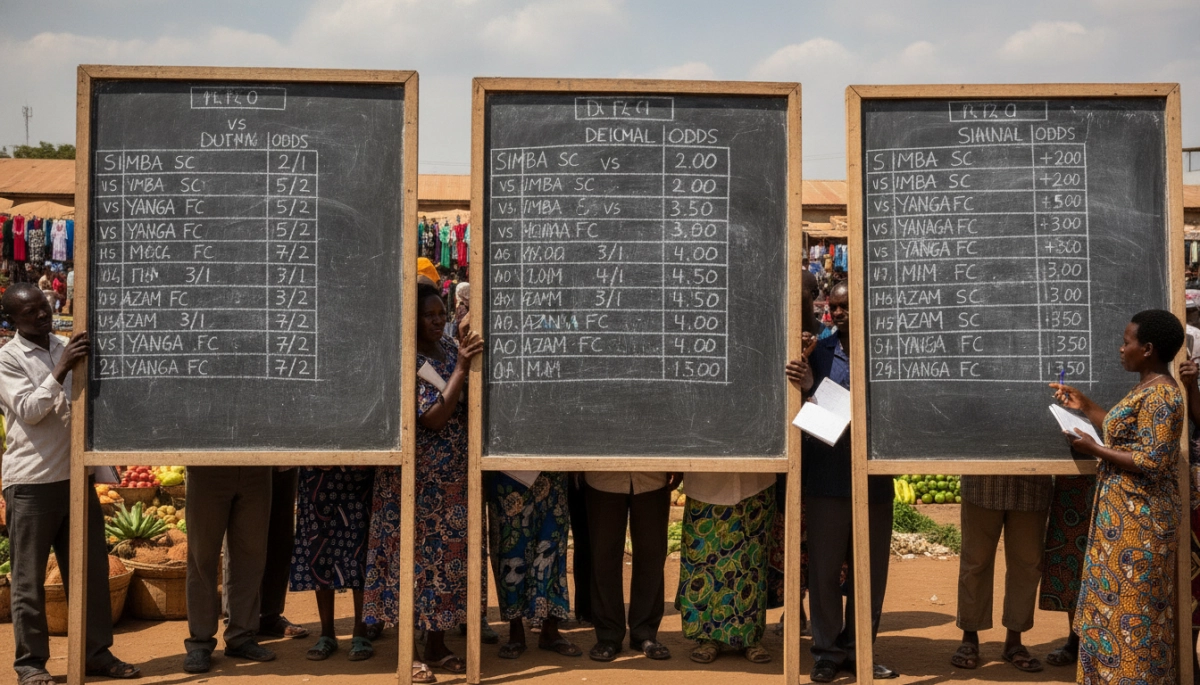

The Bet Slip Most Tanzanian Bettors Never Actually Read
Most active bettors in Tanzania spend more time picking selections than reading the slip those selections produce. The moment the last game is added, focus shifts to the potential payout at the bottom of the screen. The mechanics that determine whether that payout is realistic rarely get the same attention.
This is not a beginner’s mistake. It runs across experienced recreational bettors who follow football seriously, understand form, and still end the month down. The problem is not always the individual selections — it is the failure to evaluate what those selections mean once combined into a single slip.
What the Odds on Your Slip Are Actually Telling You
Every odd is a probability expressed as a price. A selection at 1.50 implies roughly a 67% chance of that outcome occurring. At 2.00, that drops to 50%. At 3.50, you are looking at around 29%. These figures already include the bookmaker’s margin, meaning the true probability assigned is slightly higher than the odds suggest.
When adding a selection, the question worth asking is not just whether that team is likely to win. It is whether the odds reflect a fair price for that probability, or whether the market is priced in a way that consistently works against the bettor over time. That distinction separates deliberate strategy from chasing payouts.
Odds on popular Premier League matches are heavily traded and tightly margined. Markets on Tanzanian Premier League games are thinner and sometimes less efficiently priced, but come with less data available to the bettor. Both present different kinds of risk worth recognising before a selection goes on the slip.
Why Adding More Games Does Not Add More Value
The accumulator format dominates Tanzanian football betting. The payout multipliers are visible and compelling. What is less visible is what happens to combined probability as each game is added.
Combined probability is calculated by multiplying the individual implied probabilities of each selection. If four matches each carry a 60% chance of landing, the probability of all four winning is not 60% — it is closer to 13%. A fifth selection at the same probability drops that figure below 8%. The payout grows with each addition, but the realistic chance of collecting it shrinks at a rate most bettors underestimate.
This is not an argument against accumulators. It is an argument for understanding exactly what a slip of five, six, or eight games represents in probability terms before confirming it. The potential return has a way of making that combined probability feel more manageable than it is.

Identifying the Selections Quietly Carrying Your Slip
Every accumulator has a weak link. The challenge is that weak selections rarely announce themselves — they sit in the middle of a slip looking reasonable, supported by a familiar team name or a recent run of form. Identifying them requires looking past the surface logic that placed them there.
A selection priced between 1.20 and 1.40 feels like a safe anchor. In practice, at 1.25, the implied probability is around 80% — meaning one time in five, that selection fails. Across a month of betting, something you consider near-certain will let you down regularly. When it sits inside an accumulator, that failure takes every other correct pick down with it.
Short odds do not mean safety. They mean a slightly higher probability of winning combined with a very low contribution to the overall return. A six-game accumulator built around two selections at 1.25 leans on those picks for psychological comfort while concentrating the real risk elsewhere. The slip feels grounded. The combined probability suggests otherwise.
The Problem with Fixtures That Look Obvious
Bettors everywhere tend to over-index on fixtures that feel settled — a dominant side at home against a struggling opponent, a European giant in a domestic cup, a long-unbeaten team facing newly promoted opposition. That sense of obviousness is precisely what makes these selections worth scrutinising more carefully.
Bookmakers price popular fixtures with that popularity in mind. The margin on matches with high recreational bettor volume tends to be built more aggressively into the odds. What looks like a comfortable 1.35 favourite may carry a genuine implied probability the platform estimates closer to 72% rather than the 74% the price suggests. Over dozens of bets, that compressed value adds up against the bettor.
Upsets in matches with lopsided expectations are not rare events — they are regular features of football. On a single-game bet, the loss is contained. Inside an accumulator, it is total.
Reading the Slip as a Whole Rather Than a List of Reasons
One of the most useful habits a bettor can develop is treating a completed slip as a document to interrogate rather than a list of decisions already made. Most slips are built selection by selection, each choice validated by its own rationale — form, head-to-head records, team news. By the time the slip is complete, each game has a story making it feel justified.
The problem is that individual justifications do not combine the way odds do. Five well-reasoned selections do not produce a well-reasoned accumulator. They produce a slip whose combined probability is the product of five separate chances, each capable of failing independently of whether the reasoning behind it was sound.
A more useful review process involves asking a different set of questions once the slip is assembled:
- Which selection on this slip, if it fails, would I feel least surprised by in hindsight?
- Is any selection priced in a way that doesn’t match what I genuinely believe about the probability?
- Am I adding a game for genuine value, or because the payout looks better with it included?
- What does the combined probability actually work out to, and would I accept those odds if offered as a single price?
That last question is particularly clarifying. An eight-game accumulator with a combined probability below 5% is functionally a very long-odds single bet. Presented as one selection at roughly 20.00 or higher, it looks very different than it does as eight individually justifiable picks. The slip format distributes risk across familiar choices. The mathematics collect it back into one number that deserves to be seen clearly.
The Discipline That Separates Consistent Bettors from the Rest
Reading a bet slip critically is not complicated. It does not require advanced mathematics or professional data tools. It requires the willingness to slow down at the moment most bettors are already reaching for the confirm button, and to ask honest questions about what the slip actually represents.
In Tanzania’s betting environment, where mobile platforms make it frictionless to build and place a slip in under two minutes, that pause carries real value. The speed of the process is designed to work with impulse. A bettor who reviews the full slip — not just the potential payout, but the combined probability, each selection under scrutiny, and whether any game was added more for payout than genuine conviction — is operating with a fundamentally different relationship to the activity.
None of this guarantees winning. Football produces outcomes that defy careful analysis at every level. What critical slip evaluation does is remove the avoidable losses — the accumulator collapsed by a selection that should never have been there, the slip confirmed at odds that reflected excitement rather than probability, the eight-game bet placed without registering that its realistic chance of landing was around 4%.
For bettors who want to deepen their understanding of probability and value in sports betting markets, BeGambleAware offers resources addressing both the mathematical and behavioural dimensions of responsible betting in a straightforward, non-judgmental format.
The slip does not lie. It simply requires someone willing to read it properly before the money moves.