Why Home Advantage in Tanzania Doesn’t Match the Textbook Model
Most betting content treats home advantage as a fixed variable, a small percentage bump baked into the odds regardless of where the match is played. That model works reasonably well in European leagues with standardized infrastructure, but it breaks down fast when applied to Tanzania Premier League betting. The country’s football geography is uneven, its stadium situation is genuinely unusual, and the gap between a real home edge and what bookmakers price in is wider than most bettors assume.
Understanding this gap matters because it’s one of the few structural inefficiencies a disciplined bettor can actually exploit without needing insider information or lucky guesses. It comes down to three overlapping factors: how far teams travel to play away fixtures, what conditions they find when they arrive, and how much the crowd actually shifts the outcome on matchday. None of these are abstract concepts. They show up in results week after week, and the data supports patterns that casual odds comparisons tend to miss entirely.
The Travel Problem Nobody Prices Correctly
Tanzania’s top flight spans clubs based in Dar es Salaam, Mwanza, Mbeya, Arusha, Singida, and other regions separated by long road and air connections. A club like Singida Big Stars or Mbeya-based sides making a midweek trip to the coast face a genuinely different physical reality than a Dar es Salaam team hosting a short derby trip. Fatigue, disrupted routines, and inconsistent travel logistics all compound over a long season in ways that a simple home/away split doesn’t capture.
Bookmakers operating across African markets often apply odds models built for leagues where away trips rarely exceed a few hours by train or short-haul flight. Tanzania doesn’t fit that template, and the distortion shows up most clearly when teams from the interior travel to coastal fixtures on short rest. That’s a pattern worth tracking match by match rather than assuming the market has already accounted for it.
Crowd Intensity at Mkapa and Uhuru Stadium
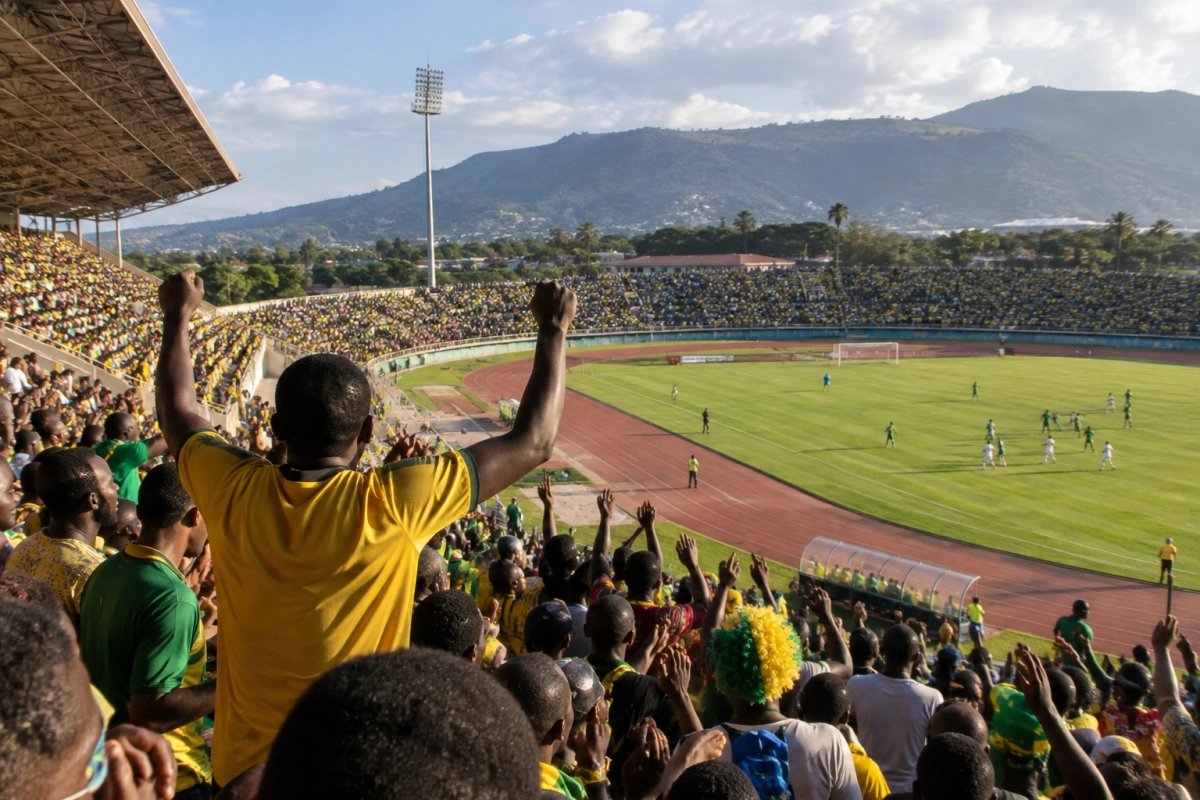
Benjamin Mkapa Stadium and Uhuru Stadium are not neutral venues in any practical sense, even though Mkapa technically hosts both Simba SC and Young Africans as a shared home ground. Crowd density, noise levels, and the sheer weight of local expectation at these grounds create pressure that visiting teams from smaller regional clubs rarely experience at their own stadiums. That pressure doesn’t always translate into cleaner football, but it does affect decision-making, discipline, and composure in the closing stages of tight matches.
The shared-stadium arrangement itself adds a layer of complexity that most odds models simply don’t account for, since two different clubs claiming the same ground as “home” should, in theory, produce comparable advantages but historically haven’t. That inconsistency is worth examining closely before looking at how pitch conditions and travel fatigue interact to shape results even further.
Pitch Conditions and the Surfaces Visiting Teams Rarely Train On
Pitch quality across the Tanzania Premier League varies far more than it does in leagues with centralized groundskeeping budgets. Some venues maintain reasonably consistent surfaces through the season, while others degrade significantly during the rainy months, producing heavier, slower pitches that reward physical, direct football over the passing game many visiting sides prefer. A club built around quick combination play in Dar es Salaam can look genuinely out of rhythm on a cut-up pitch in the interior, not because the players are inferior, but because the surface itself punishes a style they haven’t had time to adjust for.
This matters more than it sounds. Home teams train on their own surface daily and build tactical habits around its quirks, whether that’s a slope, an uneven patch near the touchline, or grass that’s kept deliberately long to slow down faster opponents. Visiting teams get a warm-up session, sometimes less, before kickoff. That gap in surface familiarity is rarely reflected in pre-match odds, which tend to treat pitch conditions as a footnote rather than a genuine tactical variable worth pricing into the match.
Referee Pressure and Local Officiating Patterns
There’s a less comfortable factor that deserves honest treatment: officiating in smaller regional grounds often operates under a different kind of pressure than it does at neutral or larger venues. Referees assigned to matches at tightly packed, vocal stadiums report a different matchday experience than those overseeing fixtures at more subdued venues, and decision-making under that kind of sustained crowd pressure isn’t perfectly consistent across the league. This isn’t a claim about deliberate bias so much as an acknowledgment that human officiating responds to atmosphere, and Tanzania’s grounds vary enormously in how intense that atmosphere gets.
Bettors who track disciplinary data over a full season, rather than isolated matches, tend to notice patterns worth factoring into pre-match analysis:
- Home sides at high-intensity grounds often receive fewer cautions in the final twenty minutes of close matches than visiting teams do.
- Stoppage time allocations can skew toward whichever side needs the extra minutes more, particularly in matches with a one-goal margin.
- Smaller clubs playing away at traditional powerhouses face a cumulative disadvantage that compounds across a season rather than appearing dramatically in any single fixture.
None of this requires conspiracy thinking. It simply means the officiating environment is one more layer sitting on top of travel fatigue, pitch unfamiliarity, and crowd intensity, and together these layers add up to something larger than the sum of their parts.
Why the Market Lags Behind the Reality
Odds compilers working on Tanzanian fixtures frequently rely on historical scorelines and basic form metrics without weighting the deeper structural factors covered above. That’s not necessarily negligence, it’s a reflection of how thinly covered the league is compared to Europe’s top divisions, where every variable gets modeled obsessively. The result is a market that prices home advantage conservatively almost everywhere outside the two or three highest-profile grounds, leaving a measurable gap between the implied probability in the odds and what actually tends to happen on the pitch.
Reading the Gap Instead of Guessing at It
None of this means the Tanzania Premier League is unpredictable in some mystical sense. It means the predictability lives in details that a quick glance at a team sheet or a league table won’t surface. The travel schedule, the condition of the pitch, the decibel level inside the stadium, and the subtle pressures acting on officials all move in the same direction more often than not, and that direction consistently favors the home side by more than the posted odds suggest. Bettors who treat these factors as background noise are leaving value on the table every matchday.
The more useful approach is to build a mental checklist before backing any away side on the road: how far did they travel, how much rest did they have, what’s the pitch likely to play like, and how loud is the ground going to be. None of these questions require specialist access, just consistent attention over time. For bettors who want a deeper statistical grounding in how home advantage is measured across football more broadly, resources like Football Database offer useful comparative context beyond Tanzania’s borders.
What makes the Tanzania Premier League worth this level of attention is precisely what makes it harder to model from a distance: the local realities are too specific, too regionally uneven, and too tied to geography and infrastructure to be captured by a generic home-advantage formula. Bettors willing to account for that complexity, rather than smoothing it away, are the ones most likely to find an edge the market hasn’t fully priced in yet.