
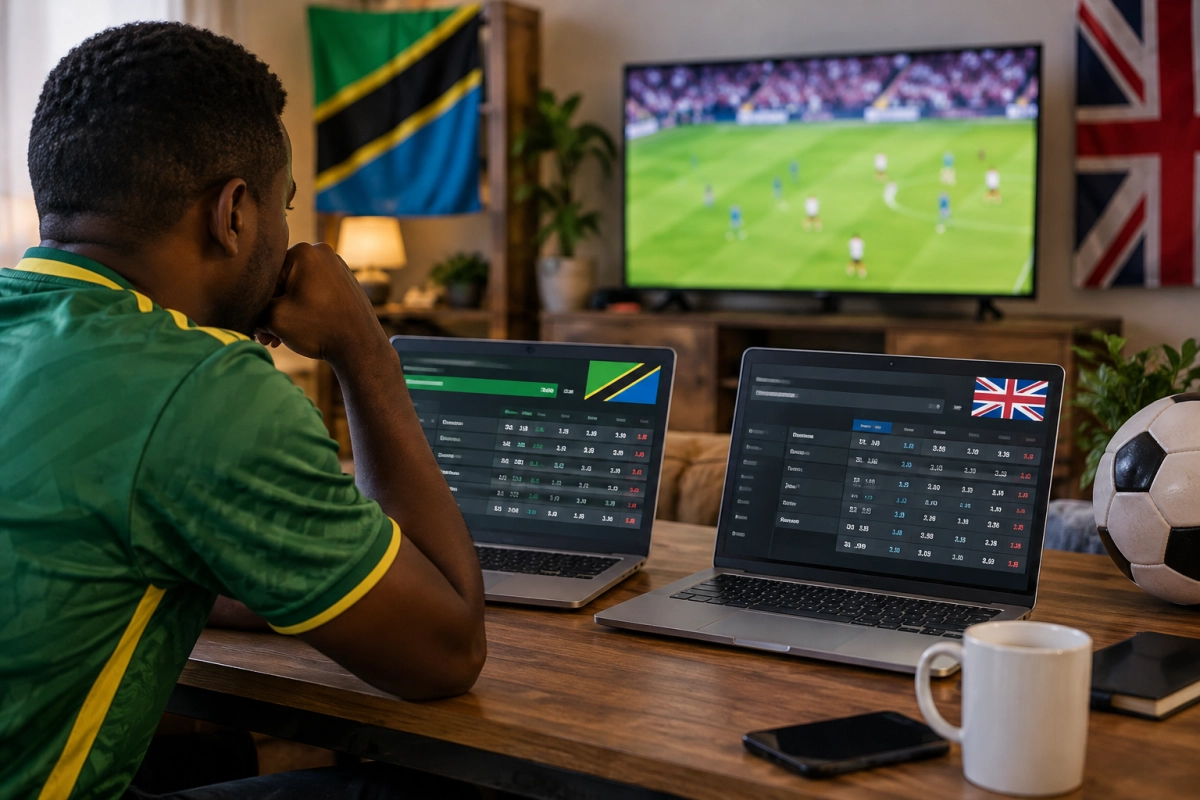
The Premier League Price You See Is Not the Price You Think It Is
Every Tanzanian bettor who has shopped the same Premier League fixture across two or three apps has noticed it. The odds on a Manchester City win might look identical at first glance, but stack them side by side and the gaps start showing. That gap is not random. It is the bookmaker’s margin, and in Tanzania it tends to run wider than what you would find on a UK platform pricing the exact same match.
Most bettors chase odds without asking why they differ. But the difference between a 3% margin and a 6% margin on the same Arsenal versus Chelsea match is not cosmetic. Over a season of regular staking, that spread quietly erodes your returns in a way no single bet slip will ever show you.
Comparing Margins Across Tanzanian and International Books
Recent margin analysis across platforms operating in East Africa found a noticeable spread. Premier Bet measured around 5.06% overround on Premier League markets, while Betika sat closer to 3.13%. Melbet landed near 3.70%, 1xBet around 4.28%, and Bet365, the UK benchmark most Tanzanian bettors compare against, came in at 4.59%.
Taken together, the spread between the cheapest and most expensive book on the same Premier League fixture reached close to 5.9 percentage points, from as low as 2.05% to as high as 7.92% depending on the operator and the match. That is not a rounding error. On a three-way match result market, that spread can be the difference between a bet that is mathematically worth taking and one that is not.
- Lower margin books: tighter pricing, less room for the bookmaker, better long-term value for disciplined bettors
- Higher margin books: wider pricing, often paired with promotional incentives or simpler market structures
- UK-facing platforms: generally sit in the middle, balancing liquidity against competitive global pricing
Why Market Depth Changes the Numbers You See
Margin size does not exist in isolation. It is shaped heavily by how much money is actually moving through a market. UK platforms pricing a Premier League match are drawing on enormous betting volume from a market where football wagering has existed in its current digital form for well over a decade. That volume lets them tighten margins because the risk gets spread across thousands of simultaneous bets.
Tanzanian mobile bookmakers are working with a shallower pool. Fewer total bets on a given Premier League fixture means the operator carries more individual risk per market, and that risk gets priced back into the odds you see on your screen. This is the part most bettors never connect to their own losses, but it explains a lot about why the same match can look so differently priced depending on where you are tapping your bet slip from.
That difference in depth does not stop at the pre-match odds. It carries directly into how fast and how far those odds move once the match kicks off, and that is where the gap between Tanzanian apps and UK platforms becomes even more visible.
In-Play Odds: The Real Test of Infrastructure
Pre-match pricing tells you how a bookmaker views risk before a ball is kicked. In-play pricing tells you something more revealing: how fast their systems can actually process what is happening on the pitch. This is where the gap between Tanzanian mobile platforms and UK bookmakers stops being about spreadsheets and starts being about plumbing.
A UK platform like Bet365 built its in-play engine around low-latency data feeds, direct relationships with official match data providers, and server infrastructure designed specifically to absorb rapid odds shifts without lag. When a goal goes in, the odds across most markets reprice within a second or two, sometimes less. That speed is not a luxury feature. It is the product.
Tanzanian bookmakers, even the well-capitalised ones, are often working through third-party data feeds that pass through more intermediaries before reaching the app on your phone. Add in variable mobile network quality across Tanzania, and the lag between a real-world event and an updated price can stretch noticeably longer. For a bettor trying to react to a red card or a sudden momentum shift, that delay is not a technical footnote. It is the difference between getting a bet matched at a fair price and getting it matched at a price the market has already moved past.
Suspended Markets and the Cost of Caution
Watch any Premier League match live on a Tanzanian app and you will notice markets freezing more often than they do on UK platforms, and staying frozen for longer. This is a direct consequence of thinner infrastructure meeting the same volatility every bookmaker has to manage. When a bookmaker cannot update odds fast enough to match live action, the safer move is to suspend the market entirely rather than risk mispricing it.
- UK platforms: shorter suspension windows, often just enough to confirm a goal or card before repricing
- Tanzanian platforms: longer suspension windows, sometimes locking a market for the better part of a minute during high-action passages
- Impact on bettors: missed entry points during exactly the moments when in-play value tends to be highest
This caution is rational from the operator’s side. A mispriced in-play market during a goal-mouth scramble can cost a bookmaker far more than a few seconds of frozen betting ever will. But for the bettor, it means the in-play experience on a Tanzanian app rewards patience differently than it does on a UK one, where speed itself becomes part of the strategy.
What This Means for How You Should Actually Bet Live
Once you accept that the infrastructure gap is real and not going away soon, the smarter move is adjusting expectations rather than fighting the lag. Chasing the exact same in-play tempo you would use on a UK platform, firing off quick reactive bets the moment something happens, tends to backfire on slower local feeds because the price you tap is rarely the price you get. Bettors who do better on Tanzanian platforms tend to wait a beat longer, letting the market settle after a suspension rather than racing to beat it.
Reading the Market Instead of Just the Odds
None of this makes Tanzanian platforms inferior or UK platforms flawless. They are simply built on different volumes, different data pipelines, and different regulatory histories, and each of those factors leaves fingerprints on the number you see before you tap “place bet.” A wider margin is not a scandal; it is a direct reflection of thinner liquidity and higher per-market risk. A slower in-play update is not negligence; it is the honest lag of infrastructure still catching up to demand that UK bookmakers have had over a decade longer to build around.
The bettors who actually benefit from this knowledge are not the ones hunting for a single “best” platform. They are the ones who treat margin size, market depth, and in-play speed as three separate signals, and who shop fixtures the way a sharp bettor anywhere in the world does, comparing the three-way line on Betika against Premier Bet, checking whether a live market reprices fast enough to trust, and knowing when a frozen screen means wait rather than refresh. For a useful external reference point on how overround itself is calculated and why it varies market to market, resources like Pinnacle’s guide to bookmaker margins remain a solid starting point for bettors who want the mechanics, not just the headline odds.
Tanzania’s mobile betting market will keep narrowing this gap as infrastructure matures and volume grows, but that shift will happen gradually, not overnight. Until then, the edge belongs to bettors who stop asking which app has the “better” odds and start asking why the odds look the way they do. That single habit, more than any tip or system, is what separates a casual punter from someone who actually understands the price they are being offered.