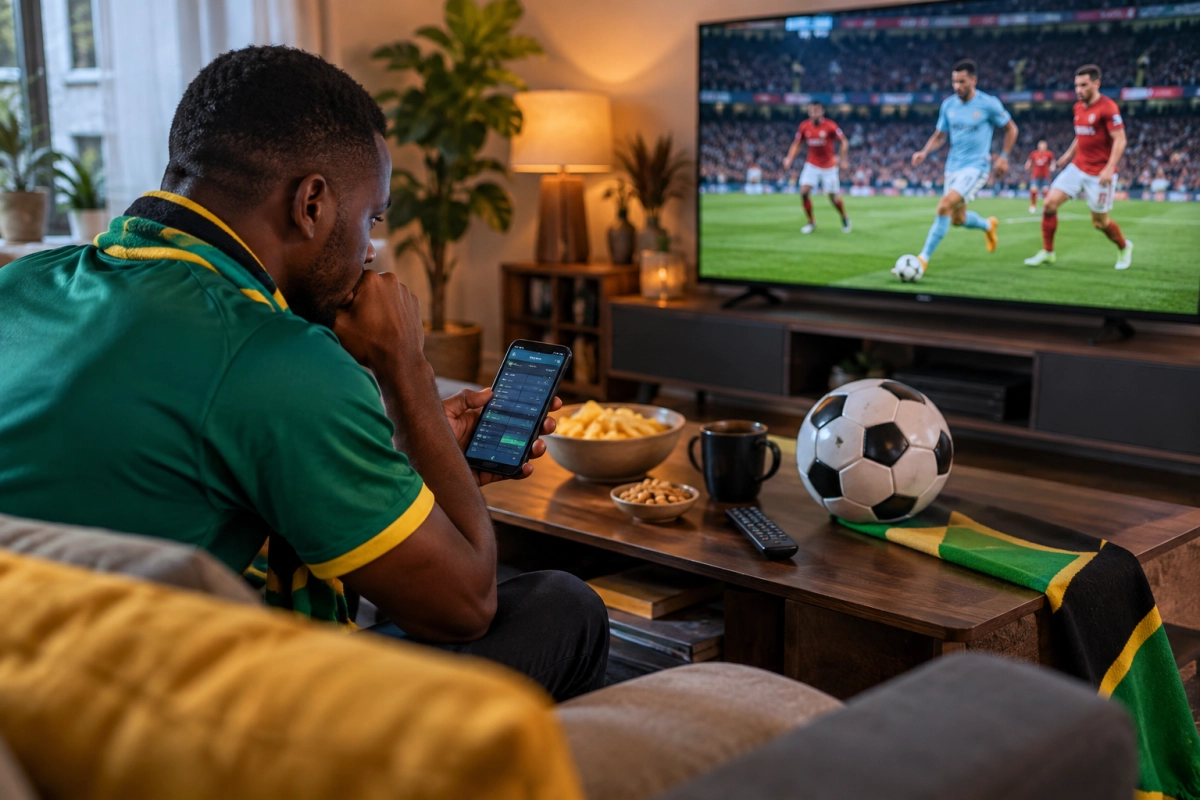

A Losing Month Is Rarely Just One Bad Weekend
You can usually name the weekend that hurt. A Saturday Premier League slip with seven legs, six of them landed, and one late goal from a team you barely watched. It feels like bad luck, so you top up from your phone and carry on.
But a losing month in sports betting is seldom one event. It is a pattern repeating across dozens of small decisions, and most of those decisions are habits rather than predictions. Five of them show up again and again among regular Tanzanian football bettors, and the first two do the most quiet damage.
Habit One: Stacking Too Many Selections on One Slip
Why the weekend accumulator feels smarter than it is
The typical Saturday slip starts with Arsenal, Manchester City and Liverpool, then adds a few local fixtures to push the total odds into exciting territory. Each leg looks safe on its own. Together, the chance that every one lands drops quickly, and the bookmaker’s margin is carried on every selection you add.
Local league legs make this worse. Data on Tanzanian Premier League sides is thin, so the prices you add are the ones you understand least. One surprise draw from a mid-table team ends the whole slip, and the three strong Premier League picks beside it count for nothing.
Even skilled accumulator bettors reportedly go through runs of 15 to 20 losing slips. If that happens to people who price carefully, a habit of seven-leg slips built on instinct will not survive a normal month.
Habit Two: Staking by Your Mobile Money Balance
How a fast top-up replaces a staking plan
M-Pesa, Tigo Pesa and Airtel Money make funding a bet almost frictionless. That is convenient, but it changes how you stake. Without noticing, the wallet balance becomes the stake: bigger after payday, smaller midweek, and rarely linked to how strong the price actually is.
The instant redeposit is the real problem. After a loss, the few seconds it takes to send another TZS 10,000 are the only pause you get, and most bettors do not use it to think. Your stake ends up reflecting your mood and your balance, not your confidence in the odds.
A fixed unit works differently. You decide at the start of the month what one unit is, as a small share of money set aside for betting, not whatever sits in your wallet. Common accumulator guidance keeps a single slip to about 2 to 3 percent of that bankroll. The exact figure matters less than the fact that it does not move when your balance does.
Oversized slips and balance-driven stakes are the structural leaks. The next three habits tend to appear once those leaks have already cost you money, when a bad Saturday turns into a chase on Sunday and the match on screen starts making decisions for you.
Habit Three: Chasing Losses With In-Play Bets
When Sunday tries to repair Saturday
A failed Saturday slip leaves a gap, and in-play markets offer the quickest way to try to close it. The match is already running, the odds move every minute, and the next goal or corner feels like a fresh chance to get even. A quick top-up and a bigger stake follow, usually placed within seconds of the last loss.
The problem is that you are now betting to recover, not because you see value. Live prices are set by people and models watching the same match you are, and they update faster than you can think. Chasing bettors tend to take whatever is available, which means short prices on a trailing favourite or an over-goals line in a match that has stalled.
A simple rule helps: after a losing slip, no new bet for a set period, and never a bigger stake than your fixed unit. If a live bet still looks good after that pause, it may be worth placing. If it only looks good because you are down, it is not.
Habit Four: Betting Because the Match Is on Screen
Popularity is not the same as an edge
Think about how a typical evening goes. The Premier League kicks off at the bar or on the screen at home, a friend mentions a big derby, and suddenly you have a bet on a match you hadn’t planned to touch. The game is visible and the talk is loud, but neither tells you whether the price is wrong.
Popular fixtures are usually the most heavily bet and the most carefully priced. Meanwhile, a quiet Tanzanian league match that nobody is showing might be where your own knowledge is strongest, if you actually follow the teams, travel conditions and lineup news. The mistake is letting the broadcast schedule choose your bets.
Before placing any selection, ask one question: what do I know about this match that the odds do not reflect? If the honest answer is “nothing, I just want to watch it with something on it,” that is entertainment spending, and it belongs in a separate, smaller budget.
Habit Five: Never Recording Results, and the Monthly Review That Fixes It
Why memory is a poor accountant
Most bettors remember the near-miss and the big win far better than the dozen small losses between them. Without a record, a month feels closer to even than it was. This is the habit that keeps the other four alive, because you cannot fix what you cannot see.
A bet log you can keep in a phone note
You do not need software. For each bet, write down:
- Date and competition (Premier League, local league, other)
- Number of selections on the slip
- Stake, and whether it matched your fixed unit
- Pre-match or in-play
- Why you placed it, in a few words
- Result and return
At month’s end, sort the entries and compare. Total profit or loss tells you little by itself. The splits tell you far more:
- Slip size: compare singles and short slips against your long accumulators.
- Stake discipline: note how many bets broke your fixed unit, and what they cost.
- Timing: check the results of in-play bets placed soon after a loss.
- Reason: separate bets with a stated price edge from “it was on” bets.
One of those four rows will almost always look worse than the rest. That is the habit costing you most, and it is the only one worth fixing first next month.
Fix One Habit, Then Let the Log Do the Rest
None of these five habits looks serious on its own. A long Saturday slip, a quick top-up, a Sunday bet to even things out, a match picked because it was on screen: each feels like a small, reasonable choice. Over a month they add up to a result that was decided well before the final whistle.
That is the useful part. A month lost to habits can be repaired through habits, and you do not need to be a sharper predictor to start. Keep slips short enough that one surprise does not wipe them out. Fix your unit so the wallet balance stops setting your stakes. Pause after a loss, and bet only where you can name your edge. Then write it all down, so next month’s review shows you the truth instead of a flattering memory.
Start small. At your next month-end review, find the single row in your log that looks worst and make one rule against it. Hold that rule for four weeks, then review again. Progress will probably look unglamorous: fewer big swings and fewer Sundays spent repairing Saturdays. But it will be measurable, and it will be yours.
If you notice that the log shows betting is costing more than you intended, or that stopping feels harder than it should, take that seriously. Free, confidential guidance is available from organisations such as BeGambleAware, and reaching out is a sound decision, not a sign of failure.
Betting will always carry risk, and no log removes it. What the log gives you is clarity about which losses came from variance and which came from your own routine. Only the second kind is yours to fix.