The Real Reason Ten-Leg Slips Feel Safer Than One Single Bet
Walk into any betting shop in Dar es Salaam or scroll through a mobile betting app on a Friday night, and you will notice the same pattern. Most slips carry six, eight, sometimes twelve selections stacked on top of each other. Ask the person placing it why, and the answer is rarely about odds theory. It is about what a small stake can turn into.
In a market where mobile money makes it effortless to stake TZS 500 or TZS 1,000 at a time, sports betting in Tanzania has developed its own logic. A single bet on a 1.80 odds match barely moves the needle on a small stake. Stack ten legs together, and that same TZS 1,000 suddenly has a shot at six or seven figures. That gap between what you can afford to risk and what you actually want to win is the real engine behind the multi-bet culture here.
How Mobile Money Stakes Shape Slip-Building Habits
Mobile money did not just make betting more convenient. It changed the size of the stakes people are comfortable risking, and that in turn changed what kind of bet feels worthwhile. When your stake is coming straight out of an M-Pesa or Tigo Pesa balance meant for airtime or transport, you are not thinking in terms of bankroll percentages. You are thinking in terms of what a tiny amount can transform into by kickoff on Sunday.
This is different from how betting markets developed in Europe, where larger average stakes made steady single-bet returns feel meaningful on their own. In Tanzania, the accessibility of micro-staking pushed the culture toward accumulators almost by default. The only way to make a TZS 300 stake feel like it matters is to multiply it across several legs until the potential payout looks significant.
The Social Pull of a Big Slip Among Friends and Betting Groups
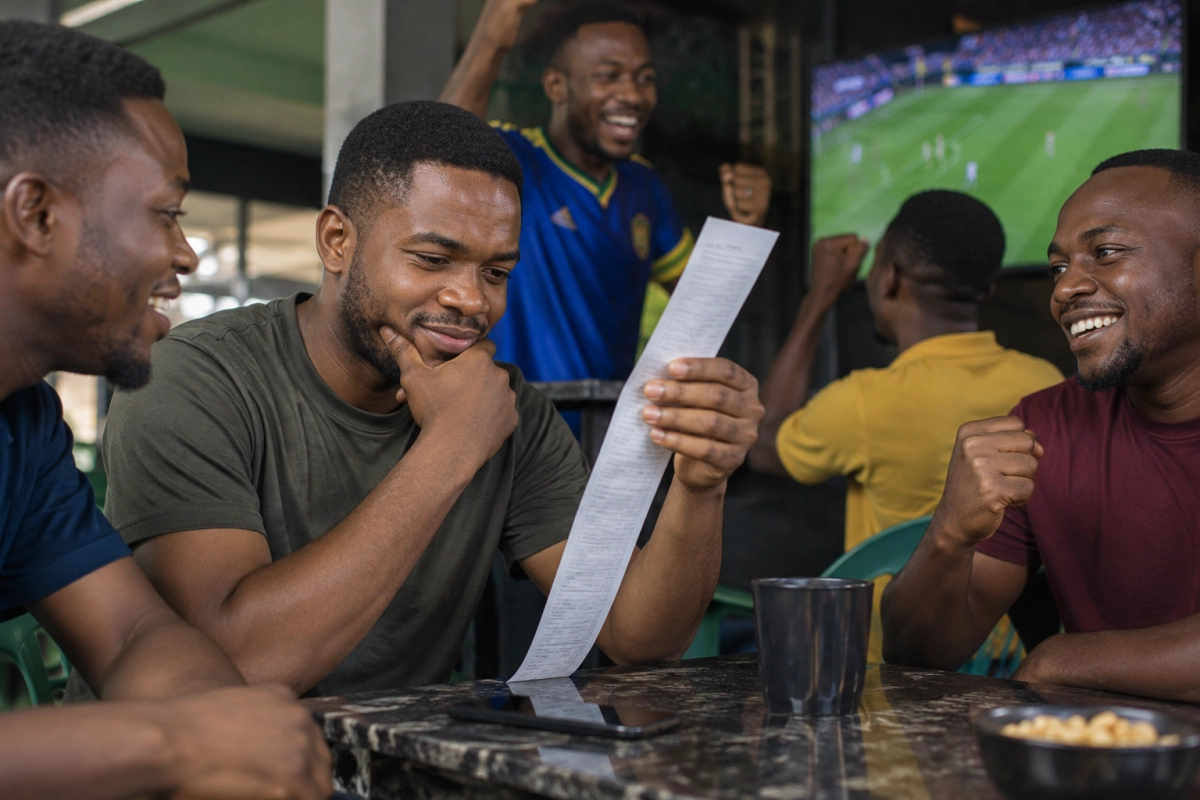
There is also a social layer to this that rarely gets discussed openly. Betting slips get shared in WhatsApp groups, compared at the local kiosk, and debated over tea before matches kick off. A long slip with Premier League favorites, a Tanzania Premier League upset pick, and maybe an esports leg thrown in feels like a statement. It shows you are paying attention to multiple leagues, not just playing it safe on one match.
That social dynamic rewards ambition over caution. Nobody posts a screenshot of a single bet on a 1.50 favorite. The slips that get attention are the ones chasing a multiplier effect, and that visibility quietly reinforces the habit every single week.
What rarely gets explained in these group chats, however, is what actually happens mathematically every time another leg gets added to that slip.
What Actually Happens to Your Odds With Every Added Leg
The math behind accumulators is simple multiplication, but the way that multiplication behaves against your actual chances of winning is where most bettors lose the plot. Combined odds grow in a straight line. Combined probability does not. It collapses, and it collapses faster than most people building a ten-leg slip ever stop to consider.
Take a slip of five selections, each at odds of 1.80, which roughly implies a 55% chance of winning on its own. Multiply those odds together and the payout looks tempting. But multiply the probabilities together instead, and the realistic chance of all five landing drops to around 5%. Add a sixth leg at similar odds and that chance falls below 3%. The slip has not gotten slightly riskier with each addition. It has gotten exponentially less likely to pay out, even though every single selection on its own looked like a reasonable, even safe, pick.
Why One Weak Leg Can Quietly Sink the Whole Slip
There is another layer to this that rarely gets discussed at the kiosk. Not all legs carry equal weight in destroying a slip’s chances. Bettors tend to build accumulators by stacking several strong favorites and then adding one or two speculative picks to boost the payout, maybe an underdog in the Tanzania Premier League or a tight scoreline on a match nobody has strongly researched.
That one speculative leg does more damage than people realize. If four selections each carry an 80% chance of winning but a fifth carries only a 40% chance, the overall slip’s chance of succeeding is dragged down disproportionately by that weakest link. The strong legs barely matter once one shaky selection is sitting in the mix. Bettors often review their losing slips afterward and blame the one leg that let them down, without realizing that leg was mathematically always going to be the most likely point of failure from the moment it was added.
The Illusion of Value When Odds Look Generous
Long slips also create a false sense of finding value simply because the total odds look big. A combined price of 45.00 feels like a discovery, like the platform is offering something rare. In reality, that number is just the product of several ordinary, even low-value, selections multiplied together. None of the individual legs needed to be underpriced or mispriced for that final number to look dramatic.
This matters because real value in betting comes from identifying odds that underestimate the true chance of an outcome, not from stacking enough fair-priced legs until the total looks impressive. A slip can look exciting and still carry zero actual value in any of its parts. Understanding that distinction is often the difference between bettors who occasionally cash out meaningfully and those who keep rebuilding the same ten-leg slip every weekend without ever stopping to ask why it so rarely lands.
Building Slips With the Math in View, Not Just the Payout
None of this means the long slip deserves to disappear from Tanzanian betting culture. It will not, and there is nothing irrational about enjoying the thrill of watching eight legs tick over one by one on a Sunday afternoon. What separates a bettor who plays for years without regret from one who keeps chasing the same losing pattern is simply whether they understand what they are holding before kickoff, not after the last leg falls.
A slip built with awareness looks different in practice. It might mean trimming a ten-leg accumulator down to five or six selections where every leg has been genuinely considered, rather than padded in purely to inflate the multiplier. It might mean separating the “fun” slip, the one built for the WhatsApp group and the long-shot dream, from a smaller, steadier bet placed with a clearer head. Both can coexist. What matters is knowing which is which before the stake goes in, not reverse-engineering an excuse once the one weak leg has, predictably, let the whole thing down.
For bettors who want to go beyond instinct and actually model how probability compounds across multiple selections, resources like the UK Gambling Commission’s public guidance on odds and risk offer a useful, jargon-free starting point, even outside its home market.
The appeal of the long slip in Tanzania was never really about ignorance of the odds. It was about what a small stake could become, and about a culture that rewards ambition over caution in public. That logic is not going anywhere. But the bettors who last longest in this game are the ones who let that ambition sit alongside a clear-eyed read of what each added leg actually costs them in probability. The slip can still be bold. It should just no longer be a surprise.