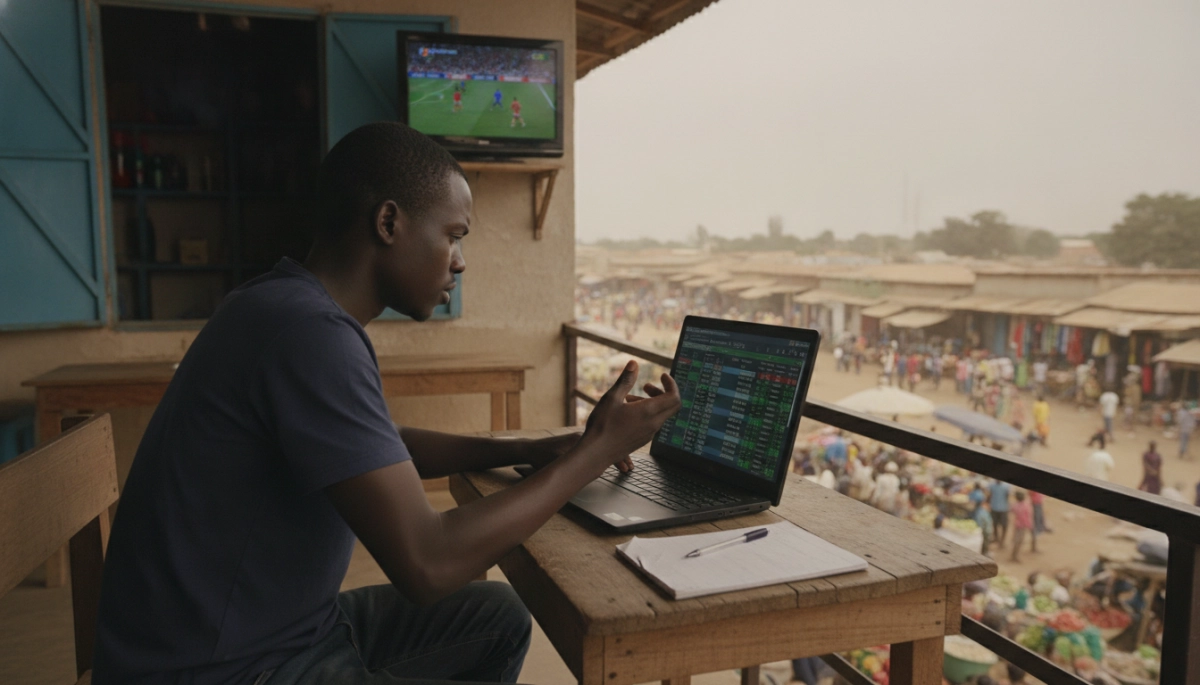

High Odds Are Not the Same as Value
Most Tanzanian bettors learn to hunt for big prices. A 4.50 on an away win in the Tanzania Premier League looks generous, so you take it. Then it loses, and you assume bad luck.
Sometimes it was bad luck. Often the price was simply fair or even poor, and nothing about it favoured you. Value betting African sports markets starts by separating how high an odd looks from whether it is mispriced.
What value actually means
Value exists when your estimated chance of an outcome is higher than the chance the odds imply. If you believe a team wins 40% of the time and the odds imply 33%, you have an edge on paper. If the odds imply 45%, you do not, however attractive the number looks.
The calculation is simple: edge = (your probability × decimal odds) − 1. Write your probability down before you open the bookmaker’s app, or the price will quietly anchor your judgment.
Turning Odds Into Probabilities and Removing the Margin
Converting decimal odds
Implied probability is 1 divided by the decimal odds. Odds of 2.20 imply 45.5%, and odds of 4.50 imply 22.2%. Do this for every outcome in the market and you will notice something uncomfortable.
Why the numbers add up to more than 100%
That excess is the bookmaker’s margin. Take an illustrative Tanzania Premier League match priced at 2.10 home, 3.10 draw and 3.40 away.
- Implied probabilities: 47.6%, 32.3% and 29.4%
- Total: about 109.3%, so the margin is roughly 9.3%
- Divide each figure by 1.093 to get fair estimates: 43.6%, 29.5% and 26.9%
Those fair figures are the bookmaker’s real opinion before the profit cushion. Your estimate has to beat them, and it has to beat them by enough to cover your own errors.
Why Tanzanian League Matches Have No Sharp Benchmark
European guides tell you to compare your estimate against a sharp line, such as a Pinnacle-style price, where heavy liquidity and professional money push odds close to the true probability. That works for the Premier League. For a mid-table Tanzanian fixture, it mostly does not exist.
Low betting volume, thin public data and limited coverage mean prices are often set from modest information and then copied between bookmakers. Margins also tend to be wider on smaller leagues. So there is no clean reference point telling you what the match is really worth.
That gap cuts both ways. Weak pricing can leave real openings, but it also means you cannot assume any single bookmaker is right. You need a substitute benchmark and a disciplined way to build your own numbers.
The next step is to build a rough probability from the limited data you can actually find, and to use several local bookmakers as a stand-in for the sharp line you do not have.
Building a Rough Probability From Limited Data
You will never have the data depth of a European model, so aim for a defensible range rather than a precise number. Start with a baseline, then adjust it.
Start with results, split by venue
Look at the last six to eight league matches for each side, but separate home from away. Some Tanzanian clubs are far stronger at their own ground, and a combined form table hides that. Note goals scored and conceded, not only wins and losses, because a lucky 1-0 tells you less than a pattern of tight matches.
Adjust for what the table misses
- Travel: Long road trips between regions can wear a squad down, especially on a short turnaround.
- Pitch conditions: A poor or uneven surface favours direct, physical sides and trims the advantage of technical ones.
- Squad rotation: Teams juggling continental or cup commitments often rest key players in league games.
- Fixture congestion: Three matches in a week usually costs more than the form table shows.
Move your baseline by a few percentage points per factor, not ten. Small, reasoned adjustments keep you honest.
Using Local Bookmakers as a Substitute Benchmark
Without a sharp line, the next best tool is a spread of prices. Check the same market at three or four licensed local bookmakers and remove the margin from each. Where they broadly agree, the consensus is a sensible reference. Where one price sits well above the rest, either that bookmaker has spotted something or it has simply been slow to adjust.
Treat that gap as a prompt to investigate, not as proof. It matters most when it agrees with your own estimate. Two independent signals pointing the same way are worth far more than one.
Also stay alert to longshot bias. Bettors overbet big prices, so long odds on draws or underdogs are often priced worse than they look. A 9.00 shot you rate at 10% is not value just because 9.00 feels exciting. Check the arithmetic: 0.10 × 9.00 is 0.90, a negative edge.
A Worked Example: Tanzania Premier League
Return to the earlier match: 2.10 home, 3.10 draw, 3.40 away, with margin-free estimates of 43.6%, 29.5% and 26.9%. Suppose the home side played midweek, is likely to rotate, and has just completed a long journey home. Your adjusted view gives the away team 31%.
- At 3.40: 0.31 × 3.40 = 1.054, an edge of about 5.4%
- Another bookmaker offers 3.50: 0.31 × 3.50 = 1.085, an edge of about 8.5%
- A third prices it at 3.30, so you ignore that one
The edge is modest and rests on your judgment, so a small stake is appropriate. Line shopping alone added about three points of edge.
Now contrast a Premier League fixture. There, a sharp-style line already reflects heavy liquidity, injury news and professional money. Your 31% against a market-implied 27% would more likely signal that you have missed something than that you have found value. The same gap means different things in each market, and that is the point.
Recording and Reviewing Your Estimates
An estimate you never check is only an opinion. Keep a simple log with the date, match, market, your probability, the odds taken, the bookmaker, the stake and the result. Record your probability before the match, and also note the best price available elsewhere, so you can see whether line shopping is helping.
Review two things separately. First, check whether your probabilities are calibrated: of the matches where you said 30%, did roughly three in ten land? A measure such as the Brier score can score your forecasts over time. Second, check whether you consistently beat the closing consensus across your local bookmakers. Beating it is a healthier sign than a short winning run.
How many bets before you can judge?
Far more than most people expect. Take the earlier example: a 31% chance at 3.40 has a 5.4% edge, but each bet swings between +2.4 and −1 units. Over 100 bets, the random noise is roughly three times the profit you expect. It takes around 850 bets before that noise shrinks to the size of the edge itself, and more than that to be confident. A few dozen bets, whether winning or losing, tell you almost nothing.
That is also why value betting guarantees nothing. A real edge improves your odds over a long run, but it does not protect any single week, month or bankroll. Stake small enough that a bad streak cannot end your record before the sample is large enough to mean something.
Playing the Long Game With Your Numbers
Value in Tanzanian football is not about finding the biggest price on the slip. It is about knowing what a price implies, stripping out the margin, forming your own view from the evidence you have, and checking it against several bookmakers because no sharp line exists to do it for you.
The discipline that matters is unglamorous: write the probability first, ignore prices that only look generous, and log every bet so the results can correct you. Some estimates will be wrong, and the record will show which ones. Over hundreds of bets, that honest feedback is what separates a real edge from a lucky stretch.