
Why Club Loyalty Quietly Costs Tanzanian Bettors Money
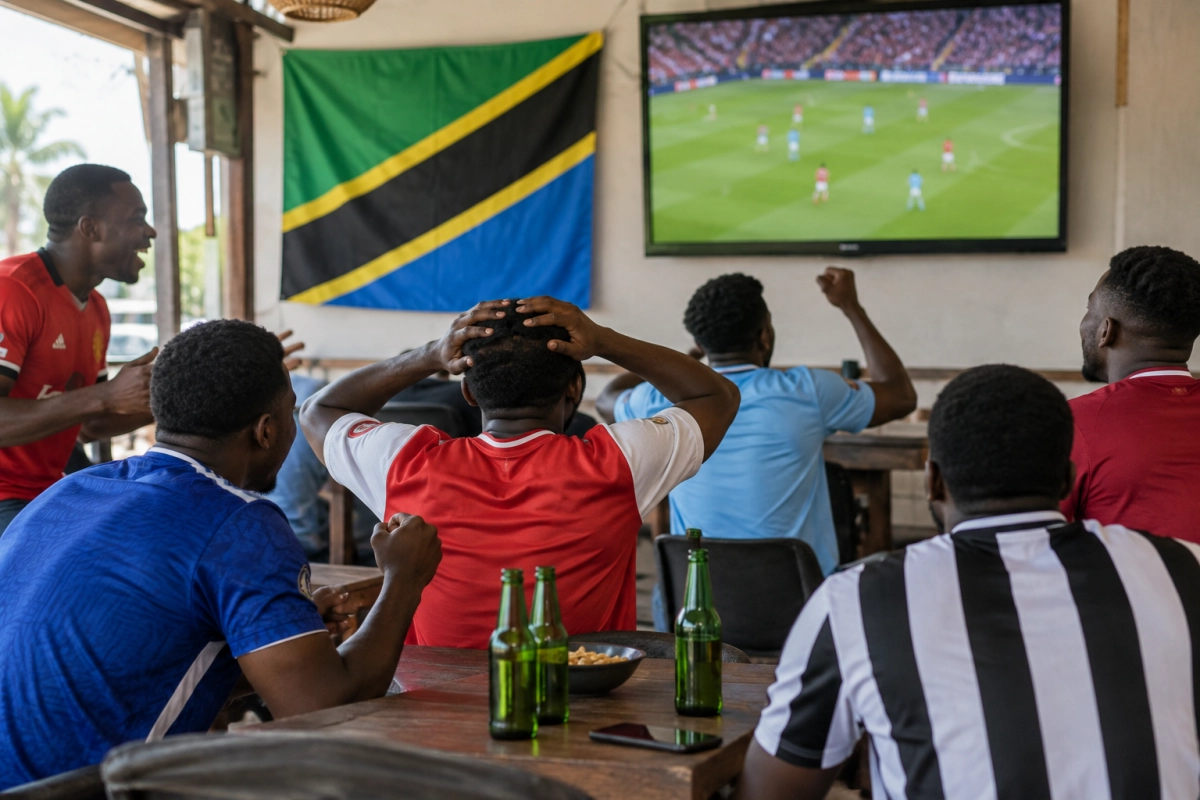
Walk into any Dar es Salaam viewing hall on a Saturday evening and the betting slips tell the story before kickoff. Arsenal shirts back Arsenal, United fans back United, and very few people are staking money against the club they grew up supporting. The loyalty is genuine. The problem is that the prices being accepted often reflect that loyalty more than the actual match.
Football betting runs deep here. A July 2026 GeoPoll survey placed Tanzania at 59 percent for football-betting participation, just behind Kenya and Ghana. When that many people bet, and most of them lean toward the same handful of English clubs, the money flowing into Premier League markets stops being balanced. Bookmakers notice this, even if bettors don’t.
How Supporter Money Shapes Local Premier League Odds
A bookmaker’s goal is not to predict results perfectly. It is to set prices that guarantee a margin regardless of the outcome. When one side of a market attracts heavy, predictable money, the operator has little reason to offer generous odds on it. Shortening the popular team’s price still draws the same fans, and each winning bet then costs the book less.
This is where local conditions matter. The Tanzanian online market is concentrated, with one operator reported to hold around 40 percent of it in 2026. A concentrated market faces less pressure to match sharper international prices. So a Chelsea or Liverpool price can drift shorter than the team’s real chances justify, and a supporter who bets on reflex will rarely notice the gap.
Where Fan Bias Meets the Favourite-Longshot Bias
Betting research has long documented the favourite-longshot bias. Longshots tend to be overpriced relative to their true chances, and bookmakers with bigger margins usually load most of that extra margin onto the underdog. In a typical market, that makes favourites slightly better value than outsiders.
Fan loyalty can flip that pattern for specific clubs. When the favourite is also the team most local bettors support, the demand can push its price below fair value, while the unfashionable opponent is left carrying odds that are more honest than they look. That is the mispricing worth hunting.
Turning Premier League Odds Into Probabilities You Can Judge
No price can be judged until it has been converted into a probability. Decimal odds convert simply: divide 1 by the odds. Fractional odds work the same way once rewritten. Arsenal at 8/11 to retain the title, as quoted in September 2026, implies roughly a 58 percent chance. Manchester City at 11/4 implies about 27 percent, and Chelsea at 8/1 around 11 percent.
Add those figures across every team in a market and the total will exceed 100 percent. That surplus is the bookmaker’s margin. It needs removing before any fair comparison is possible.
Removing the Margin Before You Compare
The simplest method is proportional. Divide each outcome’s implied probability by the market total. For a three-way match market adding up to 107 percent, a home win priced at 53.5 percent becomes a fair 50 percent. The result is the bookmaker’s own view of the match, with the overround stripped out.
This step matters more in Tanzania than it might elsewhere. The 2026/27 budget introduced a 5 percent excise duty on stakes, which eats further into already thin returns. Accepting a loyalty-shaded price on top of that leaves very little room to profit over a season.
A margin-free local price only tells half the story, though. To know whether that 50 percent is honest or inflated by supporter money, it has to be measured against a sharper benchmark, which is where the real testing begins.
Testing Local Prices Against Sharper Benchmarks
The most useful benchmark is a low-margin international bookmaker or a betting exchange. Prices there are shaped by large volumes of informed money rather than one country’s supporter base. These markets are not flawless, but they correct quickly when numbers drift, which makes them a reasonable stand-in for a team’s true chances.
The test itself is simple. Remove the margin from both the local price and the benchmark price using the proportional method, then compare the two fair probabilities. Suppose a local book implies a fair 58 percent for Manchester United at home, while the sharper market settles at 52 percent. That six-point gap is not a disagreement about the football. It is most likely the price of the shirt.
Patterns Worth Watching
Mispricing is rarely constant. It tends to cluster around certain fixtures, and knowing where to look saves time:
- Big-name clubs playing away at mid-table sides, where reputation outruns current form.
- Popular teams on a poor run or missing key players, whose local prices barely move.
- Weekend accumulator favourites. Heavy multi-bet demand on Arsenal or Liverpool gives operators little reason to lengthen their prices.
- Meetings between two widely supported clubs, where loyal money splits across both sides and the draw can be left looking generous.
Tracking the gap over several weeks reveals more than any single match. If a club’s local price sits two or three points shorter than the benchmark week after week, that is a structural bias rather than noise.
Finding Value on the Other Side of the Fan Money
Once a popular club looks overpriced, the value usually sits with the outcomes nobody in the viewing hall wants to back. If the favourite’s fair probability is inflated, the opponent and the draw are priced from a smaller share of the book. That can leave them longer than the benchmark suggests. Check each outcome individually, and bet only where the local fair odds beat the sharper line.
Alternative Markets That Soften the Bias
Many supporters find it uncomfortable to back against their own club outright, and that is not the only route. Double chance, draw no bet and Asian handicap markets let you take a position on the less popular side with reduced risk. Goals markets can also help. Fan demand concentrates on the match result, which tends to leave totals priced more neutrally.
The same discipline applies throughout. Convert the odds, remove the margin and compare against the benchmark. Then act only when the gap is wide enough to survive the excise duty and still leave a genuine edge.
Keeping a Simple Record
None of this works as a one-off check. A basic spreadsheet is enough. For each bet, note the local odds, the benchmark odds, both fair probabilities and the result. Over a season, it will show whether your selections consistently beat the sharper line, which is a better measure of skill than a lucky weekend. It will also show which clubs’ prices are most distorted by local support. That is often the club you follow yourself.
Stick to licensed operators while you do this. The Gaming Board of Tanzania oversees the market, and betting with a regulated book protects your balance and your winnings. That matters most once you start finding an edge worth pressing.
Support the Club, Price the Match
Loyalty to Arsenal, United, Chelsea or Liverpool is part of what makes Premier League weekends in Tanzania so vibrant, and nothing here asks you to give it up. It only asks you to keep the shirt and the betting slip apart. The bookmaker already knows how you feel about your club. The only question is whether you are paying for that feeling every time you place a bet.
The bettors who come out ahead over a season are rarely the ones with the boldest predictions. They check every price against an honest number, and they are content to pass when the gap is too small. Sometimes that means backing the unfashionable side. Sometimes it means taking a draw no bet or a goals line. Often it means not betting at all. Cheer for your team on Saturday, and let the numbers decide where your money goes.