
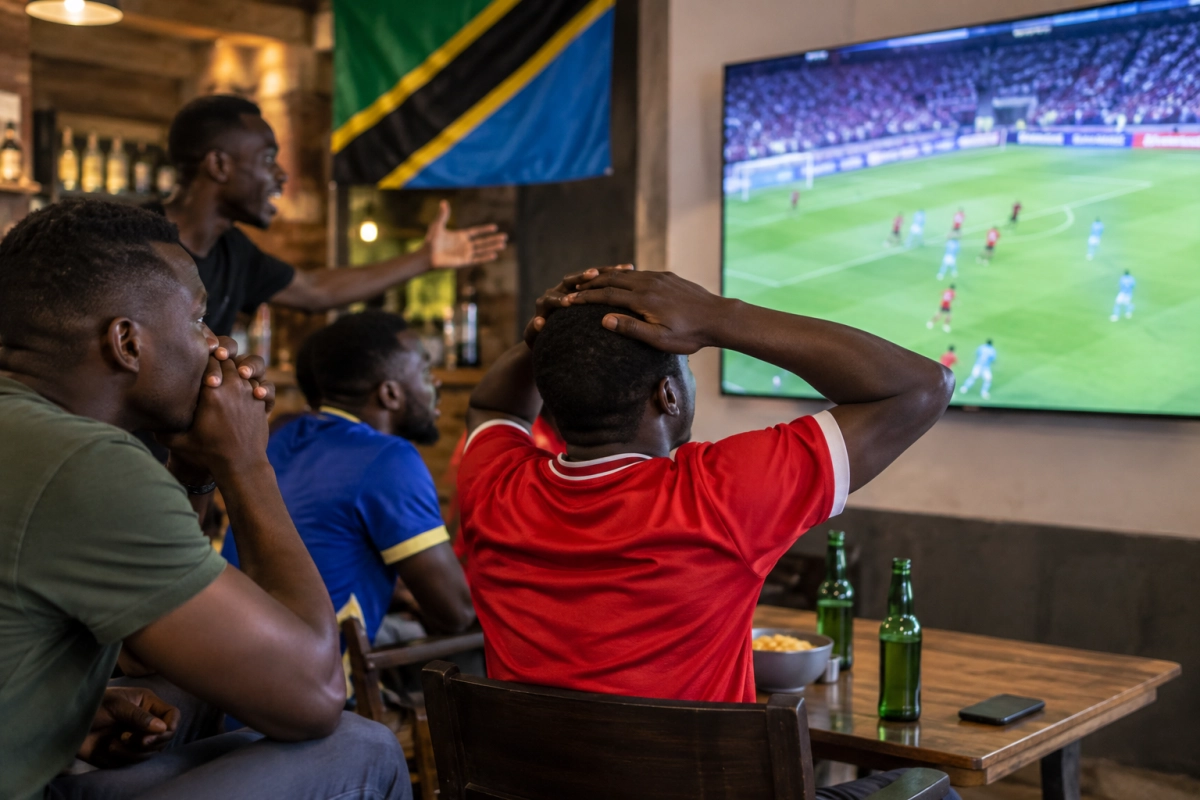
Why Tanzanian Live Bettors Are Always a Few Seconds Behind
Most Tanzanian bettors who lose in-play blame bad luck or a late goal. The real problem usually starts earlier. By the time a punter in Mwanza or Dar es Salaam sees an attack building, the bookmaker has already seen it, priced it and often closed the market.
Live betting is sold as the part of the game where sharp reading pays off. That promise assumes the bettor and the bookmaker are watching the same moment. On a Premier League Saturday or an NBC Premier League evening fixture, they rarely are.
How the Bookmaker’s Live Feed Gets Ahead of the Bettor
Bookmakers do not price in-play markets off television. They rely on live data feeds from scouts and data providers, which register a corner, a shot or a dangerous free kick almost as it happens. Broadcast footage usually trails that feed by up to 10 seconds or more, and a stream on a phone can fall further behind.
That gap is the foundation of the house’s in-play edge. Anything the bettor reacts to on screen has usually already shaped the odds. What feels like a read of the game is often a read of the recent past.
The Full Chain of Delays on a Tanzanian Phone
Broadcast lag is only the first link. Tanzanian bettors stack several delays on top of one another, and each one widens the distance from the live feed.
- Broadcast or stream lag: TV feeds, and internet streams in particular, run behind the action on the pitch.
- Mobile data latency: a drop to 3G, a congested tower in a busy area or a weak signal during heavy rain slows both the stream and the bet slip.
- Bet-acceptance delay: in-play bets are held before confirmation, usually for somewhere between 1 and 12 seconds depending on the bookmaker and the market.
- Re-pricing and rejection: if the odds move during that hold, the bet is rejected or offered at a new price, and the bettor has to try again.
Added together, these delays can leave a bettor on a patchy connection behind the data feed by more than one full attacking move. At that point the market is not being beaten. It is being chased.
Why Markets Keep Suspending at the Worst Moment
Few things frustrate Tanzanian punters more than suspended markets. Bookmakers lock betting when something significant happens or looks likely to happen, such as a goal, a possible penalty, a potential red card or a VAR check.
Because the feed runs ahead, the suspension often appears before the bettor’s screen shows any danger. The market closes while the ball still looks harmless in midfield, then reopens at a shorter price once the incident has been priced in.
Why TPL Matches Behave Differently from Premier League Games
The Premier League carries dense data coverage and deep liquidity, so live prices move in small, rapid steps. TPL fixtures tend to draw thinner coverage and lower stakes. As a result, bookmakers often protect themselves with longer suspensions, wider margins and lower maximum stakes on in-play markets.
TPL streams are also less reliable, so many bettors follow these games through a live-score app rather than pictures. That changes which markets make sense. A bettor without video is reacting to the same data the bookmaker already holds, only later.
Understanding the delay only matters if it changes what gets bet on. The next step is to measure personal lag precisely and match markets to it, because some in-play markets punish latency far less than others.
Measuring Your Own Lag Before Placing a Live Bet
Most bettors only have a rough sense of how far behind they are. That is not enough to decide which markets are safe to touch. A few minutes of testing during a match that carries no money gives a much clearer picture than any assumption about “fast” or “slow” data.
Timing a Stream Against the Data
The simplest check is to run a live-score app alongside the stream or TV broadcast. When a goal or corner appears in the app, count the seconds until the same moment shows on screen. Repeat it several times across a half, because the gap drifts as the connection strengthens and weakens.
It is worth running the test in the places where bets actually get placed. A home Wi-Fi connection, a mobile signal in a crowded bar and a phone on the move through town can produce very different numbers. A bettor who plays on the Premier League at home and the TPL on the go may effectively be two different bettors with two different lags.
Treating Rejections as a Signal
Bet-acceptance behaviour is the second measurement. Frequent rejections or repeated re-price offers on small stakes usually mean the bettor is arriving after the bookmaker has already adjusted. Rather than hitting “accept” at the new price, the better response is to step back and move to a market where timing matters less.
In-Play Markets That Hold Up Better Under Delay
The markets that tolerate latency share one trait. They are settled over a long stretch of the match rather than the next few seconds. A delay of an attacking move barely matters when the outcome depends on the next 30 or 45 minutes.
- Half-time bets: during the break nothing is happening on the pitch, so the feed has no advantage to exploit. Second-half totals, second-half result and match result markets are all priced while every bettor is looking at the same scoreline.
- Match result and Asian handicap after a clear shift: a red card, an early injury to a key player or a tactical change can reshape a game for its remaining duration. Once the market reopens and settles, the edge comes from judgement rather than speed.
- Full-match goal totals: over/under lines on the whole match move with every chance, but a bet on the overall tempo relies less on catching one specific moment.
Markets That Punish Latency Most
At the other end sit the fast, event-driven markets: next goal, next corner, next card and anything tied to the coming minute of play. These are exactly where the feed’s head start does the most damage, and where suspensions arrive before danger appears on screen.
They are especially risky on TPL fixtures followed through a live-score app. A bettor without pictures has no information the bookmaker lacks, so short-window markets become a straight race against a faster opponent.
A Simple Routine for Delayed Conditions
Bringing these points together does not require a complicated system. It mostly requires discipline about when to act.
- Know the lag first: test the stream or app against live data before money is involved, and check again whenever the location or connection changes.
- Match the market to the connection: the weaker the signal, the longer the settlement window of the bet should be.
- Use the natural pauses: half-time, and the period after a market reopens following a major incident, level the playing field more than any other moment.
- Walk away from repeated rejections: several refused or re-priced bets in a row show that the bookmaker is ahead on that market, and that chasing it will not change the outcome.
- Treat TPL in-play with extra caution: thinner coverage, longer suspensions and less reliable streams make patience even more valuable on local fixtures.
Winning the Part of the Game Speed Cannot Decide
A Tanzanian bettor will rarely beat the bookmaker’s live feed on reaction time. The data arrives first, the price moves first and the suspension lands first. Accepting that is not defeatist. It is the starting point for betting sensibly in-play.
The advantage worth pursuing lies elsewhere. It comes from reading how a Premier League side responds to going a goal down, or how a TPL match changes after a red card, and from committing to that view in markets that give it time to play out. Judgement holds its value over 45 minutes in a way that a split-second reaction never can on a delayed stream and an unsteady signal.
That same patience applies to the wider habit of live betting. The fast pace of in-play markets can blur stakes and time together, so firm limits matter as much as good market selection. Anyone betting in Tanzania can check which operators are licensed and find guidance on safer play through the Gaming Board of Tanzania.
The bettors who last are not the ones with the fastest thumbs. They are the ones who know exactly how far behind they are and choose markets where it no longer matters.