
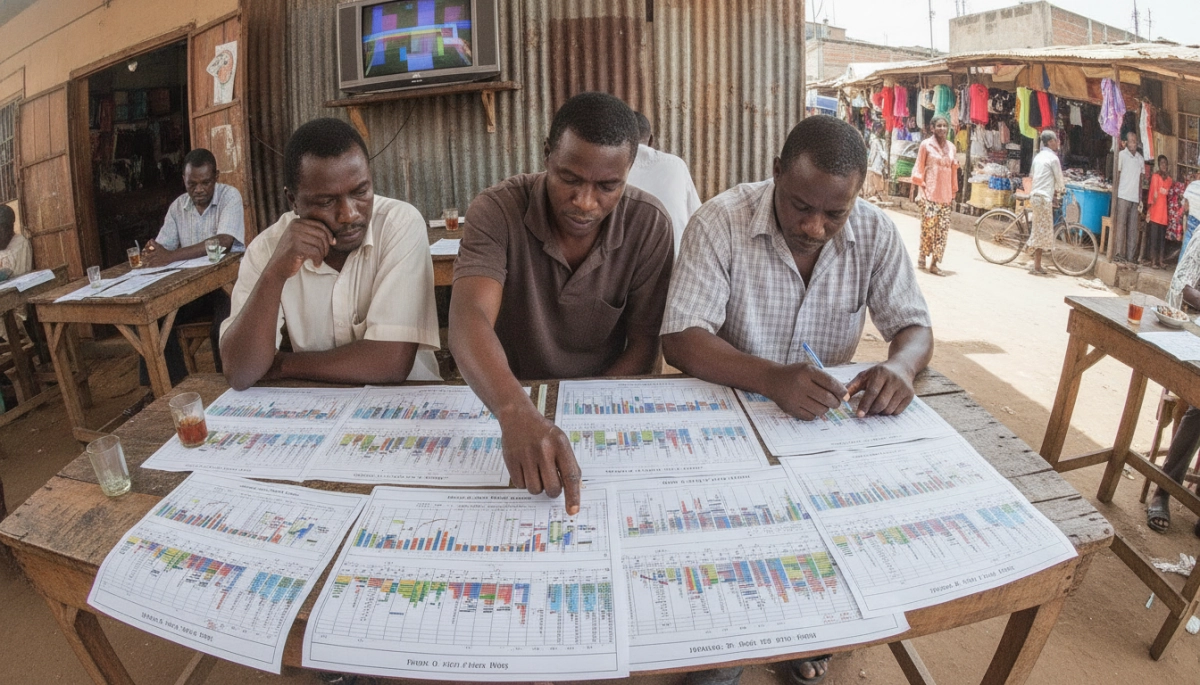
Why Most Bettors in Tanzania Are Reading Form Data the Wrong Way
There is a specific kind of mistake that experienced bettors make more often than beginners. They find form data, read it correctly by the numbers, and then apply it to entirely the wrong context. This is not a beginner error. It is what happens when the tools available do not match the market being analysed, and nobody stops to question the fit.
For anyone serious about football betting in Tanzania, this mismatch is the central problem. The statistics easiest to find online are built around European leagues — primarily the Premier League, La Liga, and the Bundesliga. Those leagues operate under conditions that have almost nothing in common with the Tanzania Premier League or regional East African competitions. Squad depth, playing surfaces, refereeing consistency, travel schedules, and data collection standards all differ substantially. When a bettor pulls xG figures or possession averages from a European stats platform to reason about a Tanzanian fixture, the analysis feels rigorous but the foundation is wrong.
The result is false confidence. The numbers give the impression of informed decision-making while the actual signal being used is noise borrowed from a different football environment entirely.
What European Form Statistics Actually Measure and Why They Do Not Transfer Cleanly
Expected goals, shots on target ratios, and pressing intensity metrics are built on large sample datasets from leagues with professional tracking infrastructure. That precision does not exist at the same level in Tanzanian league football, which means any model designed around European data is working from assumptions that simply do not hold.
Beyond data quality, there is the question of what the numbers are actually capturing. A team’s defensive line height in a European league reflects tactical choices made in a structured coaching environment with full-time professionals. In Tanzanian club football, defensive shape is often more fluid, determined as much by fatigue, pitch conditions, and matchday availability as by tactical instruction. Applying the same interpretive framework to both contexts produces conclusions that look logical but are functionally misleading.
This does not mean statistics are useless in local markets. It means the statistics need to be the right ones, drawn from sources that reflect the actual conditions of the competition, and interpreted with an understanding of what they can and cannot tell you in that specific environment.
The Data Gap in Tanzanian League Football and How Bettors Are Working Around It
The scarcity of reliable match data for the Tanzania Premier League is a real structural problem. Match reports are inconsistent, historical head-to-head records are incomplete on most platforms, and player-level statistics are rarely tracked with the depth European competitions offer. A bettor trying to build a data-informed view of a Simba SC versus Yanga SC fixture is working with far less verified information than someone analysing a mid-table Premier League game.
What this creates is not a reason to avoid local league betting. It creates a different analytical opportunity — one where contextual knowledge, squad news sourced from local media, and an understanding of how Tanzanian clubs perform under specific physical and logistical conditions can carry more weight than any stat sheet. The bettor who knows how a club’s performance shifts based on CECAFA commitments and travel load has an edge that no European statistics website can replicate.
Which Data Sources Are Actually Reliable for Tanzanian Football Analysis
The instinct for most bettors is to go where data is abundant. That usually means opening Sofascore, Flashscore, or WhoScored and treating whatever appears there with the same confidence they would give a Premier League dataset. The problem is that aggregator platforms populate Tanzanian league data inconsistently. Scores are often accurate. Lineups are frequently missing or delayed. Possession figures for local fixtures are sometimes estimates from manual input rather than automated tracking. A bettor who does not know this will treat a 54 percent possession figure as meaningful data when it may have been entered by a single contributor working from a television broadcast.
The more useful approach is to layer sources deliberately and weight them differently based on what they can reliably provide. Basic scoreline and result history from aggregator platforms is reasonably trustworthy. Beyond that, reliability falls quickly, and local sources carry far more genuine signal.
Tanzanian sports journalists and club-affiliated social media accounts frequently carry information that changes the value of a fixture substantially. A goalkeeper flagged as doubtful in a local newspaper two days before a match, or a forward photographed at training after a reported injury, will not appear on any European statistics platform. Monitoring a small number of credible local sources consistently creates an information advantage specifically calibrated to the market being analysed.
Reading Recent Form Without Misreading Context
Form streaks are seductive because they appear objective. Five wins in a row looks like momentum. Three consecutive losses looks like a team in trouble. The problem is that raw form sequences, stripped of context, are among the most misleading inputs a bettor can use — especially in Tanzanian football, where opposition quality within a run can vary enormously.
A club with five consecutive wins may have accumulated those results against relegation candidates while rotating ahead of a continental fixture. A team showing three losses may have faced the two strongest clubs in the league plus a cup tie on a difficult away surface with a depleted squad. Neither sequence tells you what it appears to without that surrounding context, and in Tanzanian football the contrast in quality across the league table is sharper than in the more financially balanced European competitions.
The practical adjustment is to evaluate recent form against the actual opposition faced, the conditions of each fixture, and any known squad disruptions during that period. When form is assessed this way, patterns that looked clear often dissolve, and the genuine signals that remain carry real analytical weight.
How Home and Away Splits Work Differently in Local East African Football
In European football, home advantage is well-documented and relatively consistent. In Tanzanian and broader East African club football, it operates through different mechanisms and produces more extreme variance.
Travel conditions across Tanzania are genuinely demanding. Road journeys between fixtures in different regions can span many hours, and the logistical burden on clubs with smaller budgets directly affects player condition by matchday. A club travelling from Dar es Salaam to an upcountry fixture the day before the match is not in the same condition as one playing at its home ground. This has no real equivalent in European football, where chartered flights and high-speed rail are standard.
Beyond travel, crowd dynamics at local grounds are considerably more intense and variable than aggregate attendance figures suggest. Certain venues generate an atmosphere that visibly affects how visiting teams approach the match from the opening minutes. Understanding which grounds carry that quality is the kind of granular knowledge a form table will never encode, but a bettor who has followed Tanzanian football attentively over time can build and apply it with genuine precision.
- Factor in travel distance and mode of transport when assessing away team condition
- Identify which clubs have consistent home ground advantages versus those that benefit primarily from familiar surfaces
- Check the scheduling gap between previous and current fixtures, particularly when one side has had continental commitments
- Note whether a fixture falls within a gruelling fixture cluster, as squad depth across Tanzanian clubs varies widely enough to make this consequential
None of these adjustments require exotic data. They require knowing what questions to ask of the information already available, and being disciplined enough to ask those questions before the European statistics framework takes over by default.
Betting With Clarity When the Data Is Imperfect
The honest reality of analysing Tanzanian football for betting purposes is that you will rarely have complete information. The data will sometimes be thin, local sources will occasionally conflict, and the contextual factors that matter most will not appear in any spreadsheet. Accepting that reality is not pessimism. It is the starting point for doing the work correctly.
What separates bettors who build sustainable analytical habits from those who cycle through the same errors is a willingness to match the framework to the market rather than forcing the market into a borrowed framework. European statistics are useful as a reference point for understanding how certain metrics behave in general. They are not a template to be pasted onto a Tanzania Premier League fixture and expected to produce meaningful conclusions. The moment that distinction becomes instinctive rather than theoretical, the quality of analysis improves across every subsequent decision.
Form data, when read with appropriate context and sourced from reliable inputs, remains genuinely valuable. A team’s recent results against comparable opposition, interpreted alongside squad availability, travel load, and venue conditions, contains real information about what is likely to happen in the next ninety minutes. In a data-sparse environment, the discipline of asking what you actually know, what you are inferring, and what you are guessing is more protective than any statistical model.
For bettors who want to go further in understanding the analytical foundations behind modern match statistics, the work being done at organisations like StatsBomb on data quality and contextual interpretation offers a rigorous perspective on how even the best datasets require careful handling. The lesson transfers directly: more data is not always better data, and better data is only better if it is asking the right question about the right competition.
In Tanzanian football betting, the edge does not come from accessing more statistics than everyone else. It comes from understanding the ones you have with more honesty and more precision than the market currently demands. That standard is achievable, and the bettors who hold themselves to it consistently are the ones whose judgement compounds over time into something genuinely useful.