
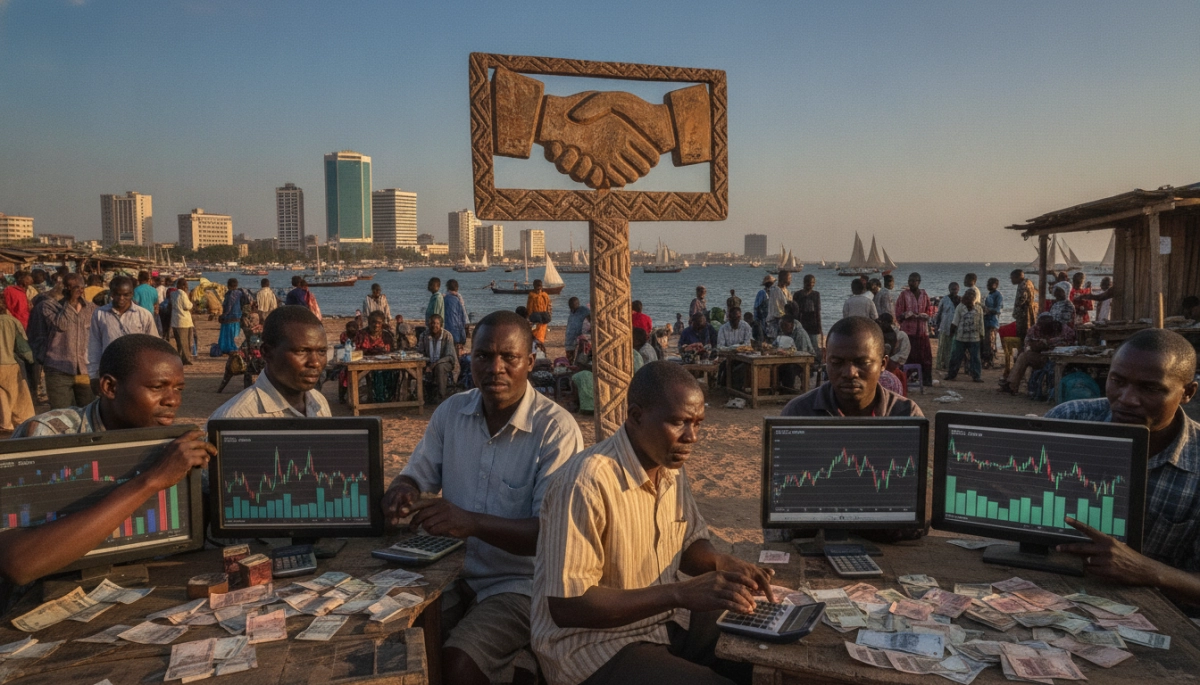
Why Odds Movement in Tanzania Does Not Follow the European Playbook
Most Tanzanian bettors who track line movement are applying logic borrowed from European betting culture — where sharp money from professional syndicates drives early price shifts and the market self-corrects in near real-time. That model does not translate cleanly to African markets, and using it without adjustment leads to misreading signals that mean something entirely different here.
The core difference is market depth. European sportsbooks handle enormous volumes across thousands of bettors, with a significant portion coming from high-stakes, analytically driven players whose bets force bookmakers to adjust. In Tanzania, the total money placed on any single match — even a popular Premier League fixture — is a fraction of what moves through a European exchange in minutes. That shallow volume changes the mechanics of how and why lines shift.
When a line moves on a Tanzanian platform, the most likely cause is not sharp professional money identifying value. It is either a bookmaker adjusting proactively based on data from international feed providers, or a sudden surge of recreational betting on one side — often triggered by social media speculation or a popular tipster. These are very different signals, and treating them the same way will consistently send a bettor in the wrong direction.
How Bookmaker Feed Pricing Creates Misleading Line Movement Locally
Most licensed Tanzanian bookmakers do not set their own opening lines from scratch. They pull prices from upstream data providers, meaning initial odds reflect what European or global markets have already priced in. When that upstream price changes due to European betting activity — a large wager placed by a syndicate in the UK — the local Tanzanian line shifts automatically, even if no Tanzanian bettor has placed a single bet.
A bettor watching odds on their mobile app sees movement and assumes local money is driving it. In many cases it is not. The price has simply been updated through a feed, carrying no information about where Tanzanian money is going. Bettors who mistake this for local sharp action will follow a signal that was never generated by their own market.
A line shortening on a Premier League match might reflect genuine sharp European action worth noting. The same shortening on a Tanzania Premier League fixture is far more likely to reflect a bookmaker manually adjusting their exposure — not a wave of informed local money arriving.
What Recreational Betting Volume Actually Does to Local Lines
In markets with thin liquidity, recreational bettors hold far more influence over price than in deep European markets. When a widely followed local tipster pushes a selection across WhatsApp or Telegram, the one-sided flow can push a line noticeably. Bookmakers respond by shortening odds to protect their liability — not because the selection has genuine value, but because too much money is stacking on one side too quickly.
This is the opposite of how most bettors interpret a shortening line. Rather than reading it as confirmation, a bettor with market awareness should ask whether the movement reflects informed analysis or crowd behaviour amplified through mobile-first communication. In Tanzania’s betting environment, the second explanation is far more common than the first.
Reading the Timing and Magnitude of Line Shifts to Separate Signal from Noise
Once a bettor understands the two dominant forces moving lines — feed pricing and recreational volume — the next skill is reading the timing and size of a movement. These variables carry more diagnostic information than the direction of the shift alone.
Timing is the more revealing of the two. A line that moves in the early hours after a market opens, before significant public betting volume has accumulated, is almost always a feed adjustment. There is no meaningful local information embedded in this movement. A bettor who sees a selection drift early and interprets it as the public fading a team is reading meaning into something generated entirely outside the Tanzanian market.
Movement immediately before kickoff tells a different story, but not always the expected one. In European markets, late sharp money is a recognised phenomenon — informed bettors wait until close to match time to limit the bookmaker’s opportunity to react. In Tanzania, late movement far more frequently reflects recreational bettors finalising accumulator selections or responding to a last-minute tipster post. Timing alone does not confirm sharp activity. It only narrows the possibilities.
Why Magnitude Matters More in Thin Markets
The size of a line movement in a shallow market is not proportional to the quality of information behind it. In deep European markets, a meaningful shift requires sustained, high-volume action from credible bettors. In Tanzania, a much smaller amount of money concentrated on one side can produce the same magnitude of shift, because the bookmaker’s liability threshold is reached far faster.
A dramatic line move on a Tanzania Premier League match can be triggered by activity that would not register as a blip on a European exchange. Bettors who use movement size as a proxy for confidence are applying a European calibration that does not hold here. A sudden ten-point swing in implied probability might represent informed European action — or a single large recreational wager from Dar es Salaam.
Treat large movements on domestic fixtures with scepticism rather than urgency. Reserve greater weight for sustained, gradual shifts that persist across multiple price updates. Gradual movement suggests the bookmaker is managing consistent one-sided flow. Sudden movement more often reflects a single event — a tipster post, a news item, or a manual adjustment — rather than informed, distributed betting activity carrying genuine predictive weight.
How Match Type Should Recalibrate Your Interpretation Entirely
The information value of a line shift varies substantially depending on whether the fixture is a European top-flight game, a continental African competition, or a domestic Tanzanian league match. Interpreting odds movement without accounting for this distinction is a reliable way to draw the wrong conclusions.
For European top-flight fixtures, Tanzanian bookmakers operate with well-resourced, frequently updated feeds. Early movement on these games carries residual signal from sharp global activity, even if not generated locally. A bettor tracking Premier League lines on a Tanzanian platform receives a delayed reflection of what a competitive international market has already processed.
Domestic Tanzanian league fixtures operate in a fundamentally different information environment. Upstream data is thinner, pricing models are less refined, and bookmakers carry more uncertainty. Lines are more susceptible to manual intervention and overreaction to one-sided flows from small sample sizes. The bettors most likely to profit are those with direct, ground-level knowledge that no feed provider has properly priced in.
- European club fixtures: movement is often feed-driven, reflecting international sharp activity but arriving with a lag
- CAF competitions: thinner global data coverage means bookmakers carry more pricing uncertainty, and local knowledge carries more weight
- Tanzania Premier League: lines are most susceptible to distortion, but also most accessible to bettors with genuine local knowledge advantages
Recognising which category a match falls into before interpreting any line movement is the foundational step that makes everything else more accurate.
What Line Movement Actually Tells You — and What to Do With It
The most useful reframe for any Tanzanian bettor is this: the question is never simply whether a line has moved. The question is what caused the movement, in which direction, at what point in the betting cycle, and on what type of fixture. Answering all four questions before acting on a price shift separates disciplined interpretation from noise-chasing dressed up as analysis.
For European fixtures, treat early movement as a delayed echo of international sharp activity — useful context, not a direct instruction to follow. If a line has already moved significantly before you encounter it, the value has likely been compressed. Arriving late to a move that originated overseas and has already been priced in is not the same as identifying value.
For domestic Tanzanian fixtures, the calculus shifts. Line movement here rarely carries clean information from sophisticated sources. The bettor with genuine ground-level knowledge — who follows the Tanzania Premier League closely, understands team selection patterns, knows which clubs travel poorly or underperform after midweek fixtures — holds an advantage no feed provider has captured. That advantage is most actionable early, before recreational volume and bookmaker adjustments compress whatever gap exists between true probability and posted price.
CAF competitions sit between these two poles. Coverage is improving but uneven, and following African football reporting closely gives bettors access to team news and context that upstream pricing models consistently underweight. When a line on a CAF Champions League fixture drifts without obvious public reason, it is worth investigating whether the movement reflects a genuine data update — or simply a thin market rebalancing itself with minimal information behind it.
Across all three categories, the discipline is the same: resist the instinct to treat movement as confirmation. A shortening line does not validate a selection. A drifting price does not expose a weakness. In a market as structurally different from European norms as Tanzania’s, those surface-level readings are unreliable by default. The bettors who consistently extract value are not the ones who follow shifts fastest — they are the ones who have learned to ask what a shift actually represents before deciding whether to act on it at all.
That kind of structural patience — slowing down at the moment most bettors speed up — is, in the end, the real edge that Tanzanian market dynamics make available to anyone willing to develop it.