
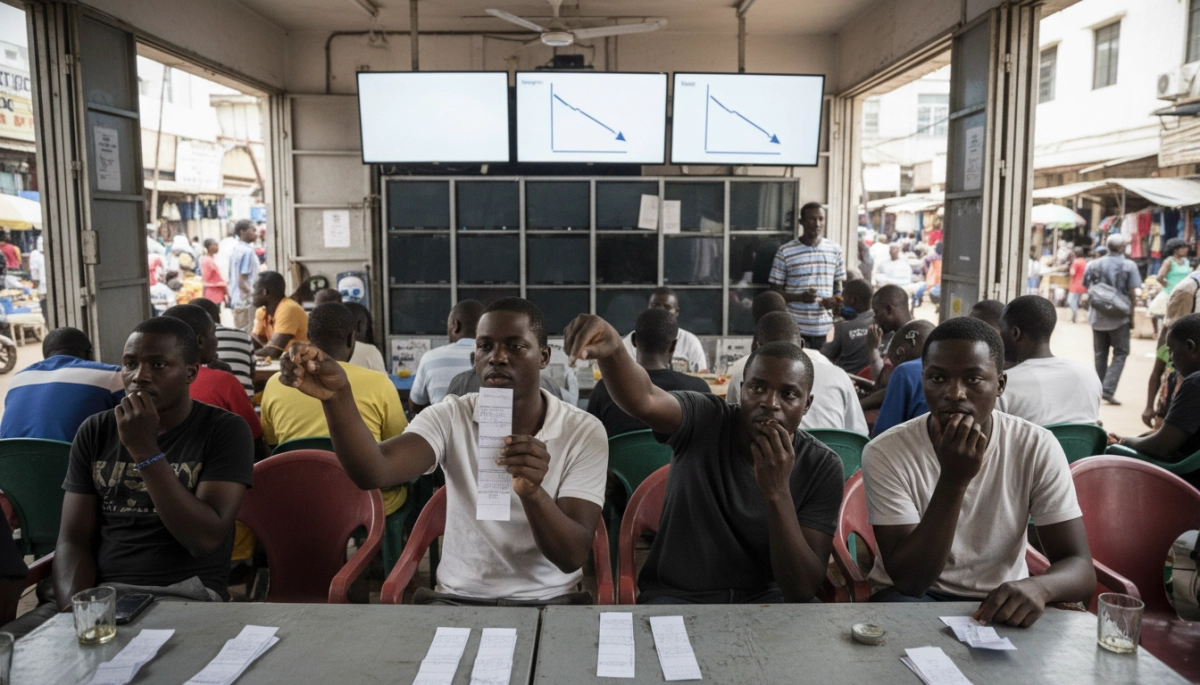
The Pattern of Losing in Tanzanian Sports Betting Is Not Random
Most Tanzanian bettors who have been at it for a while carry a quiet suspicion that something structural is working against them. They are right. The losses that accumulate over months are not simply the result of bad luck or wrong predictions. They follow a pattern with specific causes rooted in how bettors behave and how the products they use are designed to respond to that behavior.
Sports betting in Tanzania operates within a mobile-first, accumulator-dominant culture. The typical bettor builds a multi-game slip, funds it through mobile money in a few taps, and expects a meaningful return from a small stake. That setup feels efficient and exciting. It is also precisely where the structural disadvantage is steepest. Understanding why requires looking at three interconnected forces: the psychology of accumulator building, the habit of accepting odds without evaluation, and the way bookmaker margins compound across the markets Tanzanian bettors use most.
Accumulator Culture and the Mathematics Working Against the Bettor
The accumulator is the dominant bet format in Tanzania for a reason that has nothing to do with its profitability. It transforms a small amount of mobile money into the possibility of a genuinely life-changing return. That possibility is real. The probability behind it is a different matter entirely.
When a bettor selects six games, each with an implied probability of around 60 percent, the combined probability of all six winning is not 60 percent. It is closer to 4 percent. Most bettors absorb this intellectually but do not feel it, because the slip is built game by game and each individual selection feels reasonable. The accumulator format exploits exactly this disconnect between how humans evaluate sequential decisions and how probability actually compounds.
What makes this especially costly is that accumulator culture has become the default rather than one option among many. Bettors are not choosing accumulators after considering alternatives — they are building them automatically because that is how sports betting has been positioned in this environment. The single-game bet or carefully selected treble are treated as less serious options rather than the more disciplined approach they actually represent.
Odds Acceptance as the Habit That Quietly Drains Bankrolls
One of the most consistent loss-generating habits among Tanzanian bettors is accepting displayed odds without any reference point for whether they represent fair value. The number on the screen looks like information. In practice, it is a price set by the bookmaker to generate margin, and the bettor’s job is to determine whether that price is accurate or distorted. Very few bettors in this market do that evaluation — not because they lack the intelligence, but because the tools to do it have not been part of the local sports betting conversation.
The bookmaker margin embedded in every market means that a bettor who simply accepts displayed odds and bets regularly is guaranteed to lose over a large enough sample. That is not a theory. It is arithmetic. And in markets with higher margins — which tend to be the African-facing products available to Tanzanian bettors — the arithmetic works against the bettor faster than in European-facing markets with thinner margins.
How Bookmaker Margins Are Structured to Exploit Predictable Behavior
Margin is not applied uniformly across all bet types. It is concentrated strategically, and in the Tanzanian market that concentration follows local bettor behavior with uncomfortable precision. High-margin markets cluster around exactly the outcomes bettors favor most: popular European leagues, high-scoring game predictions, and both-teams-to-score or over/under selections that feel intuitive and require no deep tactical knowledge.
A bettor consistently backing Premier League matches on a Tanzanian-facing platform may face effective margins significantly higher than a European bettor sees on the same fixture. The difference rarely exceeds a few percentage points on any single market, but bettors are not placing single bets. On an eight-selection accumulator, margin compounds across every leg rather than adding linearly, producing a far steeper disadvantage than any individual market suggests.
This is not a conspiracy. Bookmakers observe which markets receive the highest volume, price those markets to protect their position, and offer better value in obscure markets that attract little traffic. The result is a systematic transfer of value away from precisely the markets Tanzanian bettors use most.
The Role of Favorite Bias in Accelerating Losses
Closely connected to margin concentration is the systematic overvaluation of favorites. Tanzanian bettors are drawn toward well-known clubs and clear form favorites not purely out of confidence, but because selecting a recognizable winner feels cognitively safer than backing an underdog or a draw. Bookmakers price favorites with full awareness of this pull. When a team like Manchester City attracts disproportionate betting volume, the bookmaker shortens the price to manage liability. The odds already reflect the collective weight of bettor sentiment, often well past the point of genuine value.
This plays out on almost every accumulator slip. The bettor assembles five favorites, each appearing to be a reliable selection, without recognizing that each price has already been adjusted downward to account for exactly that instinct. The slip looks conservative and well-reasoned. The underlying value on each selection is frequently negative before a single match kicks off.
Staking Patterns That Amplify the Structural Disadvantage
Beyond selection, the way Tanzanian bettors manage stakes introduces a further layer of structural damage. The most common staking pattern is emotionally responsive — bettors increase stakes after a losing run to recover ground, and after a win in a moment of elevated confidence. Both responses compound the existing disadvantage from margins and accumulator math.
Loss chasing is not a character flaw. It is a predictable response to how mobile betting is designed. When a bettor experiences a near-miss on a seven-team accumulator where six selections win, the platform has effectively trained them to believe a larger stake on the next attempt is a logical correction rather than an escalation of risk. The result is a staking pattern with a recognizable profile:
- Low stakes during cautious periods following sustained losses
- Elevated stakes during emotionally confident periods following near-misses or small wins
- Highest stakes at precisely the moment when variance is most likely to produce another loss
- A gradual drift toward longer accumulators as bettors seek larger returns to offset their accumulated deficit
Each of these tendencies is individually damaging. Together they create a staking profile that reliably accelerates losses. And because mobile betting makes the next stake just a few taps away, the behavioral loop is reinforced constantly without the friction that might prompt reflection.
Breaking the Pattern Requires Seeing It Clearly First
The losses Tanzanian sports bettors accumulate are not distributed randomly across bad luck and poor judgment. They follow a structure that begins with the accumulator format, runs through the habit of accepting displayed odds without evaluation, and terminates in the compounding effect of bookmaker margins applied precisely where local betting behavior is most predictable. Each element reinforces the others, producing an outcome that feels like misfortune but functions like arithmetic.
Recognizing this structure does not immediately make a bettor profitable. What it does provide is the ability to make deliberate decisions rather than habitual ones. A bettor who understands why their six-team accumulator carries a deeply unfavorable expected value can choose to build it anyway as entertainment, or choose not to. That is a meaningfully different relationship with the activity than one driven entirely by autopilot and promotional conditioning.
The practical adjustments that follow are not complicated. Reducing accumulator length — avoiding slips longer than four selections — limits the compounding of margin across legs. Developing even a basic reference habit around odds introduces friction into the acceptance process that the mobile-first environment is deliberately designed to remove. Managing stakes according to a consistent rule rather than an emotional response to the previous result removes the worst staking damage without requiring mathematical sophistication.
None of these adjustments transform sports betting into a reliable income source. The house edge does not disappear through discipline. What changes is the rate at which it extracts value, and for bettors who intend to remain in the market long-term, that rate is the variable that determines whether the activity stays sustainable or becomes destructive. Resources on responsible gambling practices make this point consistently: the bettors who sustain the activity longest treat it as a managed cost rather than a system to be beaten through persistence alone.
The mobile infrastructure that makes betting frictionless, the accumulator culture that makes it exciting, and the margin architecture that makes it profitable for operators are not separate phenomena. They are a single, coherent system. Understanding it as such is the only foundation from which clearer, less costly decisions can be made.